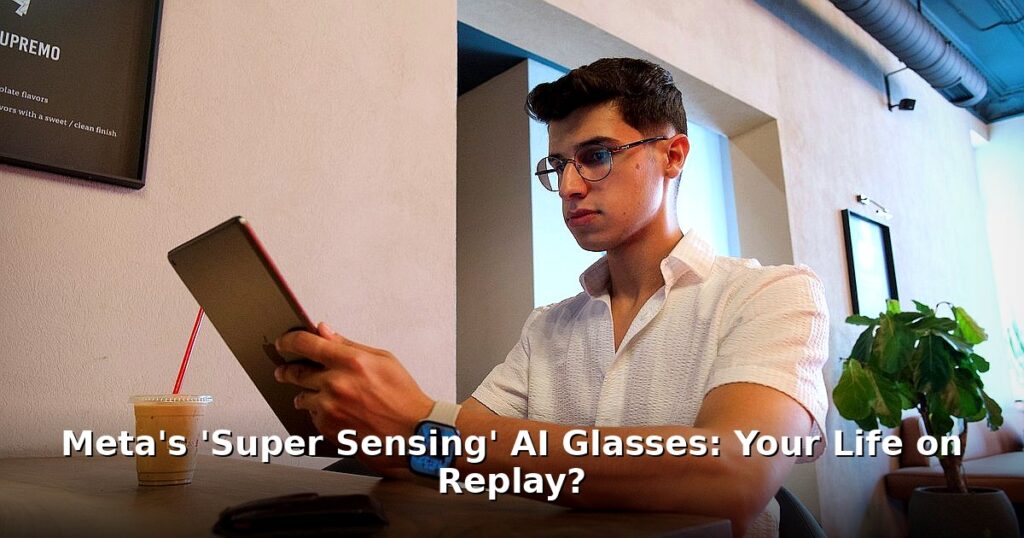

Remember that scene in Black Mirror where people could record everything they saw and replay it later? Yeah, well, Meta’s apparently not just been watching; they’ve been taking notes. And it seems they’re going for something even more ambitious. We’re talking about Meta AI glasses that don’t just record moments, but sense them, continuously, turning your entire day into a searchable, recallable stream of data. My brain just did a little flip.
Table of Contents
As someone who’s worn everything from Google Glass (the original, clunky Explorer Edition – yep, I was that guy) to the latest Ray-Ban Stories, this news hits different. It’s not just another pair of smart glasses features; it’s a potential leap into true AI wearable technology that could fundamentally change how we interact with the world, and more importantly, how we remember it. Or don’t, if the AI is doing all the heavy lifting.
The Promise of Meta’s ‘Super Sensing’ AI Glasses
So, what exactly does ‘super sensing’ even mean? It’s not just about taking a photo or a video when you tell it to. Think of it as a constant, always-on capture of your sensory experience. The glasses would continuously record visual data, audio cues, and potentially even your environmental context. This isn’t just a camera; it’s a digital witness to your life, always observing. Check out our guide on AI Chip Startup: Ex-Apple/Amazon Engineer’s Bold Mid-50s Venture. We covered this in Nintendo’s Heartfelt Message: What Fans Need to Know Now.
Here’s the thing — This goes way beyond the current iteration of Ray-Ban Stories, which, while cool for quick snaps and discreet video, are still fundamentally about discrete capture. You press a button, it records. The ‘super sensing’ concept is about advanced AI processing in real-time. It’s about the AI understanding what it sees and hears, not just archiving raw data. Imagine a personal AI assistant that doesn’t just answer questions, but genuinely remembers everything you’ve seen and heard, from your perspective.
The vision is undeniably compelling. Imagine never forgetting a name, a face, or a crucial detail from a conversation. Imagine recalling the exact layout of a room you visited months ago or the specific instructions someone gave you. This is the promise: an extension of your memory, powered by augmented reality glasses and sophisticated AI. It’s like having a digital brain-backup, constantly running in the background. Pretty wild, right?

How These Next-Gen Meta AI Glasses Might Work
At the core of these futuristic augmented reality glasses would be always-on cameras and microphones. They’d be the eyes and ears, constantly collecting data. This isn’t a new concept, but the scale and continuous nature of the collection, combined with the processing power, certainly are. It’s not just recording; it’s understanding.
The real magic, or potential nightmare, depending on your perspective, lies in the contextual AI processing. This AI wouldn’t just be recording your environment; it would be analyzing it. It would understand conversations, recognize objects, identify people, and even interpret social cues. The AI would essentially be building a rich, dynamic model of your daily life, moment by moment. It’s less about simple storage and more about intelligent indexing.
The potential applications are broad, and frankly, a bit mind-bending. Memory assistance is the obvious one – imagine meeting someone at a conference and the glasses subtly reminding you of their name and the last time you spoke. Real-time information could be another. Looking at a historical landmark? The glasses could overlay relevant facts. And enhanced interaction? Perhaps a subtle prompt during a difficult conversation, or even help navigating a new city with visual cues. These lifelogging devices could genuinely streamline aspects of our lives.
The Thrill and Trepidation: My Thoughts as an Early Adopter
Okay, let’s be honest. My tech enthusiast heart is doing a little flutter. The genuine utility here is immense. Imagine never forgetting a face again. Or recalling the exact details of that incredible dish you had on vacation. As someone who’s constantly misplacing things or forgetting names seconds after introductions, the idea of outsourcing that mental load to these Meta AI glasses is incredibly appealing. I’ve always been drawn to tech that genuinely solves a problem, and memory recall is a big one for me.
But then, there’s the ‘ick’ factor. A huge, flashing red light. Continuous recording, always-on microphones, AI analyzing my every interaction? That raises immediate, giant red flags about privacy. Not just my privacy, but the privacy of everyone around me. It’s one thing to snap a photo with intent; it’s another to have a device constantly scanning and interpreting the world without explicit consent from those in it. The thought of being in someone’s living room, or even just having a coffee with a friend, and knowing their glasses are subtly logging every word, every gesture… that’s a tough pill to swallow.
This is where balancing innovation with ethical design becomes paramount. Where do we draw the line? How much data is too much? And who gets to decide? These aren’t just technical questions; they’re societal ones. We’ve seen how quickly technology can outpace our ethical frameworks. This is a big one, a really big one.

Navigating the Privacy Minefield: A Critical Look
What surprised me was that This is the elephant in the augmented reality room. If these lifelogging devices are constantly collecting data, who owns it? Is it the user, who experiences the world through the lenses? Is it Meta, who provides the hardware and the AI processing? Or is it a shared responsibility, with complex agreements and limitations? The answer here will define the entire product category. The FTC has already weighed in on data privacy for wearables, and this takes it to a whole new level. And that matters.
The distinction between opt-in and always-on will be crucial. For products like this to gain any sort of widespread acceptance, transparency and control won’t just be important; they’ll be absolutely non-negotiable. Users need to understand exactly what data is being collected, how it’s being processed, and critically, how they can manage or delete it. An ‘off’ switch that genuinely turns off all sensing capabilities, not just a display, will be essential. Otherwise, it feels less like a tool and more like surveillance.
And what about public perception and social norms? Will people accept being constantly ‘sensed’ by someone else’s eyewear? My gut says no, not initially. There’s already a discomfort with people filming in public, even with obvious phones. A discreet device doing it continuously? That’s going to spark some serious social friction. We need clear indicators, perhaps a visible light, to show when the device is actively sensing and recording. Without that, it’s just creepy. We’ve had discussions around lifelogging for years, but this is different in scale.
The Future is Watching: What Meta AI Glasses Could Mean for Us All
If these Meta AI glasses become a reality, their impact on personal memory and cognition could be profound. Are we outsourcing our brains? If an AI is remembering everything for us, what happens to our natural ability to recall, to process, to synthesize? Will our own internal memory muscle atrophy? It’s a fascinating, if slightly dystopian, thought. We already rely so heavily on our phones for navigation and information; this feels like the next logical, and perhaps alarming, step.
On the flip side, the potential for accessibility and new forms of interaction is genuinely exciting. For individuals with memory impairments, these devices could be life-changing. Imagine a visual and auditory aid that supports daily living, helps recall loved ones’ names, or remembers medication schedules. For learning, for productivity, for simply navigating a complex world, the benefits could be enormous. And new forms of interaction? Who knows what developers will dream up once they have access to this kind of contextual, real-time data.
But let’s not ignore the broader implications for societal surveillance and data ethics. If Meta, or any company, has access to continuous streams of our personal experiences, what does that mean for privacy at scale? For targeted advertising? For law enforcement? These aren’t just glasses; they’re potential windows into the soul, and that’s a responsibility no company should take lightly. The development of AI wearable technology like this demands a proactive, comprehensive ethical framework from day one.
So, Meta, you’ve got my attention. My early adopter curiosity is piqued, but my privacy alarm bells are ringing louder than ever. Let’s hope the conversation around these super sensing AI glasses focuses as much on the ‘how’ and ‘should we’ as it does on the ‘can we.’ Big difference.
Frequently Asked Questions
Q: What are Meta’s ‘super sensing’ AI glasses?
Here’s the thing — A: These are next-generation smart glasses Meta is developing, designed to continuously capture audio and visual data from the wearer’s perspective. The ‘super sensing’ refers to the advanced AI processing this data to understand context, assist memory, and provide real-time information.
Q: How do these new AI glasses differ from existing smart glasses like Ray-Ban Stories?
A: While Ray-Ban Stories primarily focus on discrete photo and video capture, the ‘super sensing’ AI glasses aim for continuous, always-on data collection and sophisticated AI analysis. they’re less about recording specific moments and more about creating a constant digital memory stream.
Q: What are the main privacy concerns with ‘super sensing’ AI glasses?
You might not expect this, but A: The primary concerns revolve around continuous, often unnoticed, recording of individuals in public and private spaces, data ownership, potential for misuse, and the ‘always-on’ nature that could erode privacy expectations. Transparency and strong user controls will be vital.
Q: When can we expect Meta’s ‘super sensing’ AI glasses to be released?
A: These glasses are currently in the early testing and development phases, often referred to as a research project. there’s no public release date, and like many experimental technologies, they may undergo significant changes or never fully launch in their current form.