
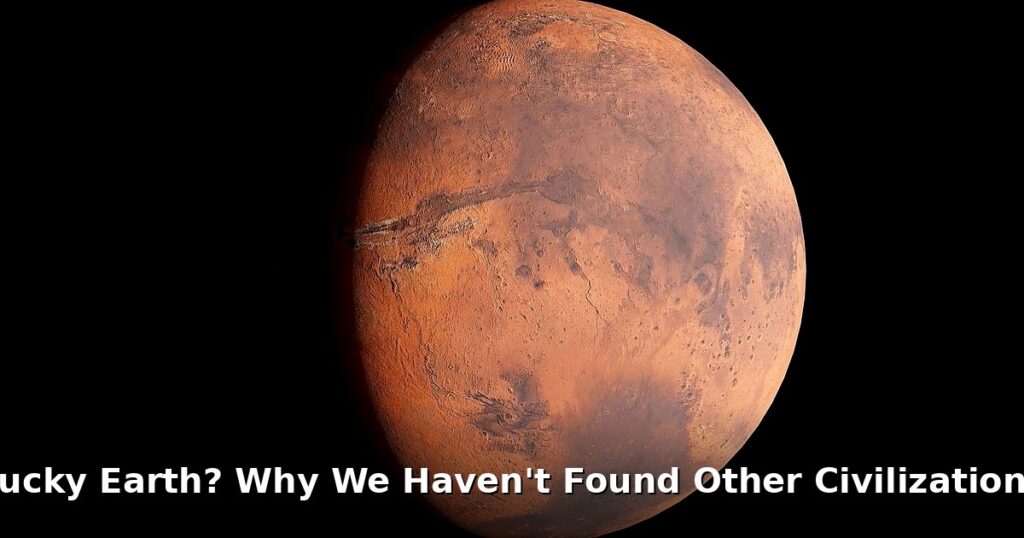

Okay, picture this: You’re sitting on your porch, gazing up at the night sky. Billions of stars, each potentially with planets orbiting them. It’s easy to imagine life teeming out there, right? So why haven’t we heard from anyone? That, my friends, is the heart of the Fermi Paradox, and it’s a question that’s haunted scientists and dreamers alike for decades. A real head-scratcher, isn’t it?
Table of Contents
The Fermi Paradox: Where Is Everybody?
The Fermi Paradox boils down to this: given the sheer size and age of the universe, the probability of other intelligent civilizations arising seems pretty high. There are billions of galaxies, each with billions of stars. Even if life is incredibly rare, simple math suggests there should be other intelligent species out there. So where are they?
That’s the crux of it. Enrico Fermi, the brilliant physicist who supposedly first posed the paradox, famously asked something along the lines of, “So… where is everybody?” If interstellar travel is possible, even at a fraction of the speed of light, then civilizations could, in theory, colonize the galaxy in a few million years. Which sounds like a long time to us, but is peanuts on a cosmic scale. Check out our guide on Light Pollution Threatens Darkest Skies in Atacama Desert. We covered this in Mirrors in the Sky: Outrage Over Proposed Night Brightening.
There are many potential answers, and they range from the plausible to the downright terrifying. Maybe they’re all hiding from each other. Maybe they destroyed themselves. Or maybe – just maybe – the conditions required for intelligent life to arise are so specific that Earth is an anomaly. Could be.
- They’re too far away to detect.
- They’re avoiding us (for good reason!).
- They’ve already destroyed themselves.
- We’re not listening correctly.
- They’re all virtual civilizations living in simulations.

The Rare Earth Hypothesis: Winning the Cosmic Lottery
This brings us to the Rare Earth hypothesis. The basic idea is that Earth isn’t just any habitable planet; it’s a remarkably lucky one. A confluence of factors had to align perfectly for complex life to emerge and thrive here. Think of it as winning the cosmic lottery – multiple times.
Okay, so What factors are we talking about? Well, for starters, there’s our stable climate. Earth’s temperature has remained relatively consistent for billions of years, allowing life to slowly evolve. That’s partly thanks to our atmosphere, which traps enough heat to keep us warm but not so much that we boil. It’s a delicate balance, really. And we’re messing with it – a cautionary tale if there ever was one.
The Moon’s Important Role
Look, Then there’s our large moon. It stabilizes Earth’s axial tilt, preventing extreme climate swings. Without the moon, our planet might wobble chaotically, leading to drastic temperature changes and making it difficult for life to gain a foothold. Plus, it gives us cool tides.
Plate Tectonics: Earth’s Recycling System
Look, Don’t forget plate tectonics. This geological process recycles nutrients, regulates the carbon cycle, and helps maintain Earth’s magnetic field. The magnetic field shields us from harmful solar radiation, which would otherwise strip away our atmosphere and sterilize the surface. All essential for making Earth habitable.
These are just a few examples. There are many other factors, such as our location in the Milky Way galaxy (not too close to the galactic center, where radiation is intense) and the presence of gas giants like Jupiter, which deflect asteroids and comets that could wipe out life on Earth. It’s a whole system that works together.
The Great Filter: Evolutionary Roadblocks
But even if a planet is habitable, that doesn’t guarantee the emergence of intelligent life. The Great Filter theory suggests that there’s a significant hurdle – or “filter” – that prevents most civilizations from reaching interstellar travel. Something stops them. It could be a biological bottleneck, a technological challenge, or even a societal collapse.
The scary thing about the Great Filter is that we don’t know where it lies. Has humanity already passed it? Or is it still ahead of us? If it’s behind us, that would mean we’re among the lucky few civilizations that have made it this far. But if it’s ahead of us, that means we’re doomed. Okay, maybe not doomed, but certainly facing some serious challenges.
Some potential filters include:
- The origin of life itself (abiogenesis).
- The evolution of complex cells (eukaryotes).
- The development of intelligence.
- The ability to avoid self-destruction (nuclear war, climate change, etc.).
Habitable Zones: Not as Simple as They Seem
The traditional definition of a habitable zone is the region around a star where liquid water can exist on a planet’s surface. But that’s a pretty simplistic view. The habitable zone definition doesn’t take into account other crucial factors, such as a planet’s atmosphere, magnetic field, and orbital stability. Big oversight if you ask me. Go figure.
For instance, a planet might be located within the habitable zone but have a runaway greenhouse effect, like Venus. Or it might lack a magnetic field and be bombarded by deadly radiation, like Mars. These planets might theoretically be in the “Goldilocks zone,” but they’re far from habitable. So location, location, location isn’t everything.
Even if a planet has liquid water, that doesn’t mean it’s suitable for complex life. The composition of the atmosphere is critical. Too much carbon dioxide, and the planet will overheat. Too little, and it will freeze. The presence of oxygen is also important, but it can also be toxic in high concentrations. It’s a balancing act.
Revisiting the Fermi Paradox: Are We Just…Lucky?
So, let’s bring it all together. The Rare Earth hypothesis suggests that the conditions required for complex life are incredibly rare. Honestly, the Great Filter theory suggests that there’s a significant hurdle that prevents most civilizations from reaching interstellar travel. And the habitable zone definition is more nuanced than we initially thought.
Could it be that Earth is just exceptionally lucky? That the combination of factors that made our planet habitable is so improbable that it’s only happened once – or a handful of times – in the entire galaxy? It’s a sobering thought, but it’s a possibility we have to consider. Might be a bit arrogant to think we’re not lucky.
If that’s the case, then the Fermi Paradox is resolved. There are no other civilizations out there because Earth is unique. Or, at least, exceedingly rare. This has huge implications for the search for extraterrestrial intelligence (SETI). It means we might be wasting our time listening for signals from alien civilizations that don’t exist. Or maybe we just need to listen harder…
So, Are We Alone…For Now?
Maybe. The truth is, we don’t know. Finding other civilizations is hard, really hard. The distances are vast, the challenges are immense, and the universe is a very, very big place. And we’ve only been looking for a relatively short time.
We need to continue exploring and researching. We need to refine our search methods, expand our understanding of habitable zones, and keep an open mind. And who knows, maybe one day we’ll finally hear that signal. That would be amazing. And it would change everything.
But until then, we have to acknowledge the possibility that we’re alone. Or, at least, very early to the party. And if that’s the case, it places a tremendous responsibility on us to protect our planet and ensure the continuation of life. Because if we screw it up, there might not be anyone else to pick up the pieces. Something to think about next time you’re considering that home improvement project that might hurt the environment…
Frequently Asked Questions
Q: what’s the Fermi Paradox?
The Fermi Paradox is the contradiction between the high probability of extraterrestrial civilizations existing and the lack of any evidence for them.
Q: what’s the Rare Earth hypothesis?
The Rare Earth hypothesis suggests that the specific conditions required for complex life to evolve are extremely rare, making Earth a unique case.
Q: what’s the Great Filter theory?
The Great Filter theory proposes that there’s a significant hurdle or obstacle that prevents most civilizations from reaching interstellar travel.
Q: Is there evidence of alien life?
To date, there’s no confirmed evidence of alien life. The search continues through SETI and other scientific endeavors. Just something to think about.
Q: What are the implications if we’re alone in the universe?
If Earth is truly unique, it places a great responsibility on humanity to preserve our planet and ensure the continuation of life.