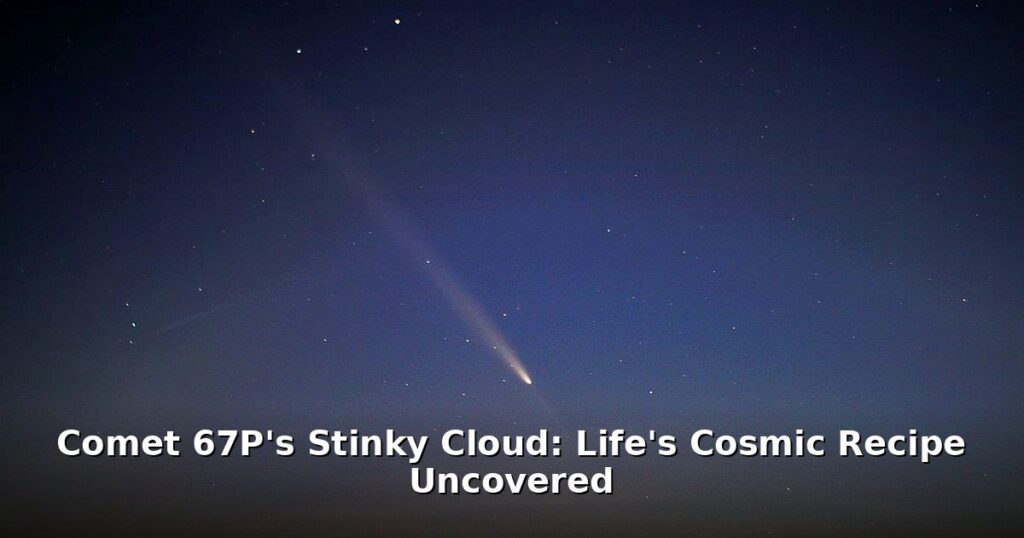

If you’ve been looking into Comet 67P gas cloud, imagine catching a whiff of something truly awful. Not just a stinky garbage can or a clogged drain, but a cosmic stench – a mix of rotten eggs, ammonia, and bitter almonds. Sounds like a nightmare, right? Well, that’s exactly what the European Space Agency’s Rosetta mission discovered when it got up close and personal with Comet 67P/Churyumov-Gerasimenko (or just Comet 67P for short). This wasn’t just any old smell, though. Hidden within that pungent cloud of gas were some of the very chemical ingredients that may have helped life begin right here on Earth.
Table of Contents
For years, we’ve looked to the stars, wondering about our origins. And part of that quest involved sending probes like Rosetta on incredible journeys. It’s truly amazing what we can learn when we send a robotic explorer billions of miles through space to essentially “sniff” an alien world. This particular mission wasn’t just about pretty pictures; it was a deep the fundamental chemistry of a comet, trying to understand what these icy wanderers are made of and what secrets they hold.
Sniffing Out the Truth: Rosetta’s Discovery at Comet 67P
The Rosetta mission, launched in 2004, was an ambitious undertaking. Its main goal was to rendezvous with Comet 67P, orbit it, and even deploy a lander, Philae, onto its surface. Talk about a gutsy move! After a decade-long journey, Rosetta finally caught up with the comet in 2014, and that’s when the real work began. It spent over two years studying 67P as it orbited the Sun, collecting unprecedented data. Just something to think about. Check out our guide on Meteor Explodes Over US, Shakes Homes: What We Know. We covered this in Trees vs. Stars: Earth’s Three Trillion Trees & Why They Matter.
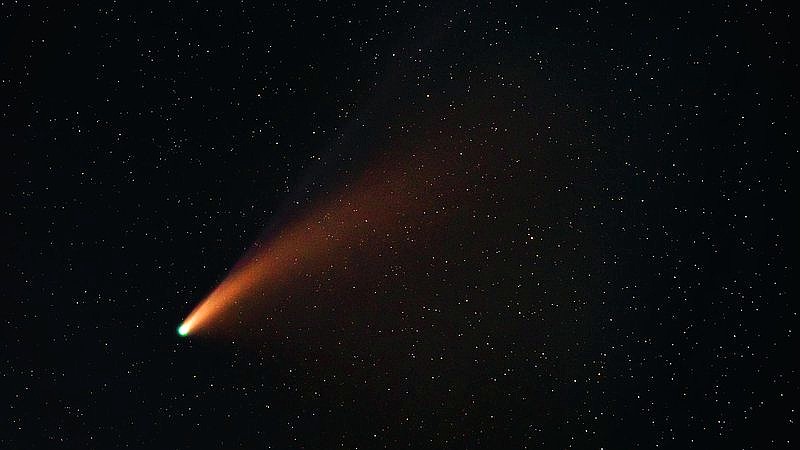
One of Rosetta’s key instruments was the Rosetta Orbiter Spectrometer for Ion and Neutral Analysis (ROSINA). This wasn’t a nose in the traditional sense, but a highly sophisticated set of mass spectrometers designed to analyze the composition of the gases emanating from the comet. As Comet 67P warmed up near the Sun, its ice began to sublimate, releasing a diffuse cloud of gas and dust – its coma. ROSINA meticulously analyzed this coma, essentially taking a detailed chemical inventory of the comet’s atmospheric exhalations.
And boy, did it find a cocktail. The data revealed a complex mix of organic molecules, many of which had never been detected on a comet before. It was like opening a cosmic spice cabinet, but instead of cinnamon and nutmeg, you got hydrogen sulfide and hydrogen cyanide. Not exactly appetizing. But for scientists looking for the building blocks of life, it was pure gold.
The Pungent Perfume of the Comet 67P gas cloud: A Detailed Whiff
Let’s get down to the nitty-gritty of that smell. When we talk about a “cosmic stink,” we’re not exaggerating. The primary culprits for this rather unpleasant aroma included:
- Hydrogen Sulfide (H2S): This is the gas responsible for the classic “rotten egg” smell. It’s a common byproduct of decomposition here on Earth, and finding it in significant quantities around Comet 67P was a strong indicator of the comet’s primordial chemistry.
- Ammonia (NH3): You know this one. It’s that sharp, pungent odor often found in cleaning products. Ammonia is a crucial source of nitrogen, an element absolutely essential for forming amino acids and DNA.
- Hydrogen Cyanide (HCN): This is where the “bitter almond” smell comes in. But don’t let the pleasant-sounding descriptor fool you; hydrogen cyanide is highly toxic. Despite its toxicity, it’s also a simple organic molecule that can readily participate in reactions to form more complex compounds.
But the list didn’t stop there. Rosetta also detected a slew of other organic molecules, including formaldehyde, methanol, sulfur dioxide, and various hydrocarbons. These aren’t just random chemicals; they’re the kind of stuff that gets chemists excited because they’re the precursors to even more complex organic structures. Think of them as molecular LEGOs, ready to be assembled into bigger, more intricate creations.
Why are these particular chemicals so noteworthy for abiogenesis – the process by which life arises from non-living matter? Well, for life as we know it, you need a few key ingredients: carbon, hydrogen, oxygen, nitrogen, sulfur, and phosphorus. The molecules found in the Comet 67P gas cloud provide several of these essential elements in forms that are relatively reactive. Hydrogen cyanide, for instance, is a crucial precursor for nucleobases (the building blocks of DNA and RNA) and amino acids (the building blocks of proteins). Formaldehyde can polymerize into sugars. It’s all connected.
Ingredients for Life on Comets: A Cosmic Delivery Service
The presence of these complex organic molecules on a comet strongly supports a long-standing hypothesis: that comets, and perhaps asteroids, acted as cosmic delivery vehicles, ferrying these vital ingredients for life on comets to early Earth. Our planet, in its infancy, was a hot, chaotic place, constantly bombarded by impacts. It’s possible that the very conditions needed for these molecules to form weren’t stable here initially. But out in the cold, dark reaches of the solar system, inside comets, these molecules could persist.
When these comets slammed into early Earth, they wouldn’t just bring water (another crucial component for life), but also a rich supply of organic compounds. Imagine billions of years ago, a comet impact isn’t just a destructive event, it’s a fertilizer bomb. A gift from the cosmos, if you will, kickstarting the chemical reactions necessary for life to emerge.
From Cosmic Stink to Building Blocks: Linking Comet Chemicals to Life
So, you have a planet covered in water, warmed by a young sun, and then bam! A comet delivers a load of hydrogen cyanide, formaldehyde, and ammonia. What happens next? This is where the magic of chemistry comes in. Under the right conditions – perhaps in tidal pools, hydrothermal vents, or even just within the comet’s melted ice – these simple organic molecules can react. No joke.
For example, in the presence of water and certain minerals, hydrogen cyanide can polymerize and react with other compounds to form amino acids. Amino acids are the fundamental units that link together to create proteins, which are the workhorses of all living cells. Proteins do everything from catalyzing reactions to providing structural support. And it’s not just amino acids; the same kind of chemistry can lead to the formation of nucleobases and sugars, which are essential for DNA, RNA, and cellular energy.
The early Earth was a dynamic environment. Volcanic activity, lightning storms, and ultraviolet radiation from the sun provided energy for these chemical transformations. The presence of water, in particular, acted as a solvent, allowing these molecules to interact and form more complex structures. It’s a complex puzzle, but the pieces provided by comets like 67P fit remarkably well into the picture of how early life might have started.
The Early Earth Chemical Origins: A Shared Cosmic Heritage
This idea of comets providing the initial building blocks is truly profound. It suggests that the early Earth chemical origins might not have been purely terrestrial. Instead, our origins could be a blend of homegrown chemistry and ingredients delivered from the far reaches of our solar system. It ties us directly to the greater cosmos, making us, in a very real sense, children of the stars.
The Rosetta mission’s findings of the specific organic molecules in the Comet 67P gas cloud provided direct observational evidence for this hypothesis. Before Rosetta, it was more theoretical. Now, we’ve got the data. We’ve smelled the cosmic stink, and it smells like potential.
Beyond Comet 67P: What This Means for Understanding Life in the Universe
Here’s what most people miss: The implications of Rosetta’s findings extend far beyond just understanding our own planet’s history. If comets in our solar system are rich in these organic molecules, it stands to reason that comets in other star systems could be too. This significantly increases the probability that the ingredients for life are widespread throughout the galaxy. It means that the universe might be absolutely teeming with the raw materials needed for life to emerge.
This doesn’t mean life is everywhere, of course. You still need the right conditions – a stable planet, liquid water, an energy source, and enough time. But knowing that the cosmic smell of Comet 67P is so rich in life’s precursors makes the prospect of life elsewhere feel a lot more tangible. It shifts the question from “Are the ingredients there?” to “Are the conditions right?”
Future missions will undoubtedly build on Rosetta’s legacy. We’ll likely see more probes designed to sample comets or even return samples to Earth for detailed lab analysis. Imagine being able to crack open a piece of a comet in a lab and study its pristine, ancient chemistry. That would be a for astrobiology.
Ultimately, Rosetta’s incredible journey to Comet 67P reminds us of the profound interconnectedness of everything. The very atoms that make up our bodies, the molecules that drive our cells, might have their ultimate origin in the dusty, icy hearts of comets, formed billions of years ago in the primordial cloud from which our solar system was born. It’s a humbling thought, and one that makes you appreciate even a rotten egg smell a little bit more, knowing what it might represent.
Frequently Asked Questions
Q: What mission studied Comet 67P?
A: Comet 67P was extensively studied by the European Space Agency’s (ESA) Rosetta mission. Rosetta orbited the comet for over two years, sending down a lander named Philae.
Q: What chemicals did Rosetta find in Comet 67P’s gas cloud?
A: Rosetta detected a mixture of gases including hydrogen sulfide (rotten eggs), ammonia, hydrogen cyanide (bitter almonds), formaldehyde, methanol, and sulfur dioxide. These organic molecules are crucial for life.
Q: How could these comet chemicals contribute to life on Earth?
You might not expect this, but A: Scientists hypothesize that comets like 67P delivered these complex organic molecules to early Earth through impacts. These compounds could then serve as the raw materials or ‘building blocks’ for the first life forms.
Q: Does Comet 67P still smell bad?
A: Comet 67P still emits gas and dust as it gets closer to the sun, so its ‘smell’ is an ongoing characteristic. But, you’d need to be in space near the comet to experience it, as the gases are extremely diffuse.