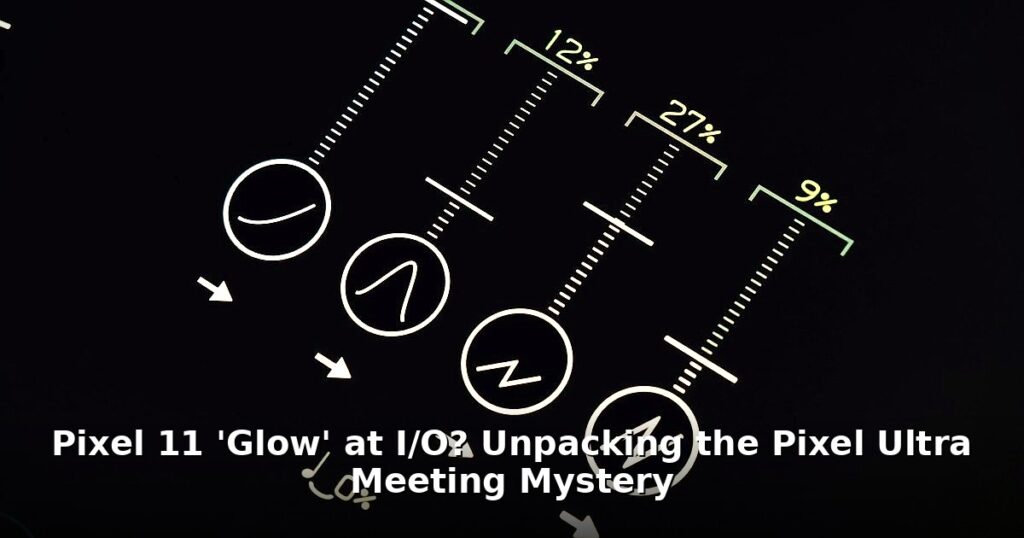

Okay, so I/O just wrapped, and as always, the tech world went into an absolute frenzy dissecting every single frame of every presentation. It’s a tradition, really. But this year, a particular blink-and-you-miss-it moment had everyone talking about a potential Pixel flagship phone reveal and, even wilder, the return of the Pixel Ultra myth. You know the one. That almost mythical, super-premium Google phone we’ve been hearing about for years.
Table of Contents
There was this subtle visual effect, this almost imperceptible “glow” that popped up on screen during one of the AI demos. And just like that, the rumor mill spun up to 11. Was this a new Pixel 11 feature? Was it some kind of ambient display tech? People immediately jumped to conclusions, and honestly, who could blame them? Google loves its little Easter eggs, especially at I/O.
But let’s pump the brakes for a second. Was that really a tease for something called ‘Glow’ on the next Google Pixel? Or was it, perhaps, something far less dramatic? Check out our guide on Kingdom Hearts Switch Demos Removed: What Happened to the Cloud Versions?. We covered this in Flipper One: The Team Needs Your Help to Launch Their New Device.
The I/O Tease: Was That Really Pixel 11’s ‘Glow’?
During the I/O keynote, as Sundar Pichai and others walked us through the latest advancements in Gemini and other AI models, a certain visual flair appeared. It was a subtle, almost ethereal light effect, pulsating or expanding around certain UI elements. Not in every demo, but enough times to catch the eagle eyes of the internet’s most dedicated Pixel sleuths.
The immediate reaction? “Oh, that’s the Pixel 11’s new ambient display feature!” or “Finally, Google’s bringing some serious visual pizzazz to its phones!” The idea of a ‘Glow’ feature, something that perhaps intelligently lights up parts of the screen based on notifications or context, sounded incredibly cool. It felt like something Google would do—subtle, smart, and tied into their AI-first approach.
But when you really looked at the visual evidence, was it truly distinctive enough to be a product tease? Or was it just… an animation? A fancy way to highlight a UI element during a demo that was, let’s remember, all about AI and new ways to interact with it? I lean towards the latter. It felt more like a visual cue to draw attention to the AI’s “thought process” or its interactions with the user interface rather than a specific feature coming to a phone.
Deconstructing the ‘Pixel Ultra Meeting’ Rumor Mill
Okay, so Now, this is where things get really interesting, and a little bit tangled. Concurrent with, or perhaps even fueling, the ‘Glow’ speculation, was the resurgence of a particularly juicy rumor: the “Pixel Ultra meeting.” This wasn’t a visual tease from I/O; it was an alleged leak from a few weeks prior, hinting that Google was having internal discussions about a super-premium device.
What surprised me was that The origins are murky, as these things always are. It wasn’t a clear-cut image of a slide or an internal memo. Instead, it was more of a whisper network, a tech journalist or leaker hearing from “sources” that an “Ultra” tier Pixel phone was being discussed at a high level. What exactly was said? Not much in terms of specifics. No specs, no design details, no release window. Just the tantalizing phrase: “Pixel Ultra meeting.”
Here’s what most people miss: And boom. That’s all it takes sometimes. This connects directly to the long-standing ‘Pixel Ultra’ white whale – a concept that has floated around since the very first Pixel phones. It’s the idea that Google isn’t just making a Pixel and a Pixel Pro, but something even more. A phone that truly pushes boundaries, perhaps with even more advanced camera tech, a wildly innovative display, or a unique form factor. Think Apple’s ‘Ultra’ branding, but for Google.
Why ‘Glow’ Probably Isn’t a Pixel 11 Feature (and What it Might Be Instead)
Let’s be real for a moment. Google’s typical I/O strategy isn’t to subtly tease a specific phone feature like ‘Glow’ during an AI demo. I/O is for platform stuff. It’s for Android, for AI, for developer tools, for Wear OS, for generalized smart home initiatives. Hardware, particularly specific phone features, usually gets a brief mention, maybe a quick glimpse, but rarely a detailed, interactive tease of something so specific. They save that for the big fall hardware event.
So, what are the alternative explanations for that ‘Glow’ effect? My money is on one of these:
- A Generic AI UI Element: This is the most likely. As I mentioned, it could simply be a visual representation of the AI at work. A digital ‘aura’ around the text or images the AI is processing or generating. It makes the AI feel more alive, more responsive.
- An AR Demo Visual: Some of the I/O demos leaned heavily into augmented reality concepts. A ‘Glow’ could be an element designed to show how digital information might interact with real-world objects in an AR environment. It’s an illustrative effect.
- A Thematic Animation: Google often uses consistent visual language throughout its presentations. This ‘Glow’ might just be part of a broader design aesthetic for the AI demos, meant to convey intelligence, fluidity, or interconnectedness.
And let’s consider the engineering challenge for a moment. A truly dynamic, intelligent ‘Glow’ feature that could light up parts of the display with precision, adapt to content, and not drain the battery like crazy? That’s a huge undertaking. It would require specialized display tech, advanced processing, and incredible software optimization. To debut it as a subtle background element at I/O, almost by accident, seems highly improbable for a mainline Pixel 11 feature.
Look,

The Enduring Myth of the Pixel Ultra: What Google is REALLY Doing
The idea of a ‘Pixel Ultra’ just refuses to die. It’s like the Loch Ness Monster of smartphones. Every few years, someone spots a blurry photo or hears a faint rumor, and suddenly, everyone’s convinced it’s real. Why does this idea persist despite Google never officially confirming anything? I think it boils down to aspiration.
Tech enthusiasts, myself included, always want to see companies push the envelope. We want to imagine what Google could do if they truly went all out, unconstrained by typical flagship phone margins or mass-market appeal. We fantasize about a phone that’s to the Pixel Pro what the Pixel Pro is to the standard Pixel – a significant leap. A truly no-compromise device.
Okay, so But Google’s current strategy, and frankly, a very successful one, is all about differentiating their Pro models. The Pixel Pro phones already offer top-tier camera hardware, exclusive software features, larger and brighter displays, and often more RAM. they’re Google’s answer to the iPhone Pro Max and the Samsung Galaxy Ultra. They’re already the premium tier.
Creating a super-premium tier, an ‘Ultra Ultra’ if you will, would create a strange segmentation problem. How do you justify that phone? What features would it have that the Pro doesn’t, beyond just higher specs that few would notice? Would it be a folding phone? (We already have the Pixel Fold.) Would it have a truly revolutionary camera system? Perhaps. But making that a distinct “Ultra” line, rather than just building those advancements into the next Pixel Pro, seems like an unnecessary complication.
My predictions for the next Google Pixel flagship phone are far more grounded: refinements to the existing lines. We’ll likely see the Pixel 9 and Pixel 9 Pro. Expect even better camera processing (because it’s Google), a more efficient Tensor chip, maybe a slight design refresh, and continued advancements in their AI integration. Things like improved call screening, better contextual awareness, and more interaction with Gemini will be the real stars. Not necessarily a new ‘Ultra’ brand, but just a better Pixel.
My Take: Don’t Hold Your Breath for a Pixel Ultra (Yet)
As an early adopter who’s fallen for countless “super phone” rumors over the years, I’m telling you: temper your expectations. I’ve seen the whispers about the “iPhone Pro X” that would have a laser keyboard, or the “Samsung Galaxy Phoenix” with a holographic display. They rarely, if ever, pan out as expected. Companies often experiment with radical ideas internally, but bringing them to market as a new, distinct, super-premium product line is a whole different beast.
Google’s strength, their absolute superpower, lies in AI and software. It’s not necessarily about chasing specs for an ‘Ultra’ phone that would cost $1500 and only appeal to a tiny niche. They excel at making smart, intuitive phones that their massive AI and cloud infrastructure to deliver experiences you can’t get anywhere else. That’s where they differentiate themselves, not just by packing in more megapixels or RAM.
What I’m actually excited for in the next Pixel lineup? Beyond the marketing hype, I want to see how they refine the camera experience even further. I’m keen to see if the Tensor chip can truly close the efficiency gap with Qualcomm and Apple, leading to even better battery life. And most importantly, I want to see how Gemini and other AI capabilities become even more deeply integrated into the OS, making the phone feel truly proactive and helpful. That’s the real next Google Pixel, not some mythical ‘Ultra’ that exists only in our collective tech dreams. Go figure.
The ‘Glow’ was probably just a cool UI animation. The ‘Pixel Ultra meeting’ was likely just brainstorming. And the next Pixel will probably be great because it builds on Google’s strengths, not because it’s chasing an imaginary beast. Seriously.
Frequently Asked Questions
Q: What was the ‘Glow’ at Google I/O?
A: During Google I/O, a visual effect appeared on screen that some speculated was a new Pixel 11 feature called ‘Glow.’ However, it was likely an artistic or functional UI element for an AI demo, not a specific phone feature tease.
Q: Is Google releasing a Pixel Ultra phone?
A: The concept of a ‘Pixel Ultra’ has been a recurring rumor for years, suggesting a super-premium Pixel phone. As of now, Google hasn’t officially confirmed any plans for a Pixel Ultra, focusing instead on their standard and Pro models.
Q: What’s the difference between Pixel and Pixel Pro?
The truth is, A: Pixel phones are Google’s flagship devices, with Pro models typically offering larger screens, more advanced camera hardware (like telephoto lenses), and sometimes higher refresh rates or additional features compared to the base models.
Q: When can we expect the next Google Pixel announcement?
A: Google typically announces its new flagship Pixel phones in the fall, usually in October. I/O generally focuses more on software and broader AI initiatives, with hardware often getting a brief tease or a dedicated fall event.