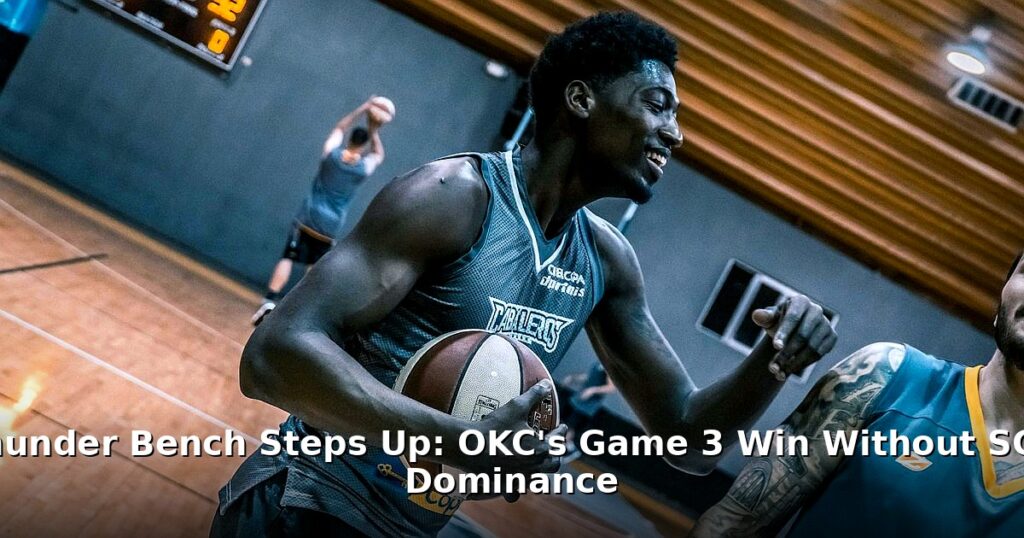

Alright, let’s be honest. When Shai Gilgeous-Alexander isn’t absolutely cooking, the Oklahoma City Thunder usually struggle. That’s just the reality when you have an MVP candidate carrying such a massive load. But Game 3? Oh man, Game 3 was different. It was a revelation, something deeper brewing in OKC. We saw a collective effort that not only picked up SGA on a relatively quiet night (by his lofty standards, mind you) but actually elevated the entire team to a critical win. And the biggest story from that game? Without a doubt, it was the Thunder bench. They didn’t just contribute; they dominated, they inspired, they flat-out won us that game.
Table of Contents
You expect your stars to be stars, especially in the playoffs. Shai usually delivers those jaw-dropping moments, the clutch buckets, the impossible drives. In Game 3, he was still good, don’t get me wrong – 20 points, 6 rebounds, 8 assists, and 2 steals. That’s a solid stat line for almost anyone else in the league. But for SGA? We’ve come to expect 30-plus, hyper-efficient, bending-the-defense-to-his-will performances. He wasn’t quite that guy in Game 3, and for a while, it felt like the team might falter because of it. The opponent was playing tough, physical defense, making every possession a grind. Go figure.
Here’s the thing — That’s when the cavalry arrived, not in the form of another star, but from the unsung heroes waiting patiently on the sidelines. The bench unit, often lauded for their energy but sometimes questioned for their consistent scoring punch, stepped up in monumental fashion. They didn’t just fill a void; they created their own offensive explosion. We’re talking about 39 points from the reserves, a number that jumps off the box score when you consider the stakes. That’s nearly 40% of the team’s total offense! Their efficiency was impressive too, hitting timely shots and keeping the offense flowing when the starters needed a breather or were facing tough defensive pressure. It was a beautiful display of team basketball, showcasing the depth and resilience of this young squad in the Oklahoma City Thunder playoffs. Check out our guide on Arsenal Finally Champions? Ending the Premier League Title Wait. We covered this in Wembanyama’s Huge Night: 4 Takeaways From Spurs’ Double-OT Win.
Isaiah Joe’s Sharpshooting: A Spark Off the Bench
If you blinked, you might’ve missed some of Isaiah Joe’s magic, but if you were watching closely, you know exactly how critical he was. This man is a pure shooter, and in Game 3, he reminded everyone why he’s so valuable. Every time the momentum felt like it was shifting, or the opponent started to creep back into the game, Joe seemed to materialize with a clutch three-pointer. His ability to hit those shots, often contested, is just incredible. It’s not just the points, though those 12 points on 4-of-5 shooting from beyond the arc were absolutely vital for bench scoring NBA. Thing is, it’s the psychological impact. A timely three feels like five points when it sucks the air out of the opponent’s arena and reignites your own team’s spirit. Pretty wild, right?
Joe’s sharpshooting did more than just add numbers to the scoreboard; it fundamentally changed the opponent’s defensive scheme. Suddenly, they couldn’t just pack the paint and focus solely on stopping SGA’s drives. Joe’s presence forced them to extend their defense, creating more space for others to operate, whether it was a drive-and-kick opportunity or a cleaner look in the post. That floor spacing is an analytical dream, opening up angles that just weren’t there when the defense could afford to sag off.
And let’s not forget his defense. It often goes unnoticed because his offense is so flashy, but Joe consistently works hard on that end. He’s not a lockdown defender, no, but he stays in front of his man, contests shots, and provides a level of effort that’s infectious. That commitment on both ends of the floor is what makes him such a valuable piece of this Thunder bench unit.
Jaylin Williams’ Gritty Play and Unsung Contributions
When you talk about energy and hustle, Jaylin Williams’ name should be one of the first that comes to mind. This guy just brings it, every single possession. In Game 3, his impact was palpable, even if it didn’t always show up in the scoring column. He had 10 rebounds, which is massive for a bench big, especially when you’re battling against a physical frontcourt. But it wasn’t just the number of rebounds; it was the timing. He grabbed offensive boards that led to crucial second-chance points and defensive boards that stifled their opponent’s opportunities and kickstarted fast breaks. Those are the plays that change games.
Williams is also an incredibly intelligent defender. His ability to switch onto smaller guards and hold his own is a huge asset for this team, especially in the playoffs where matchups are constantly being exploited. He disrupts passing lanes, challenges shots at the rim, and generally makes life difficult for opposing offenses. He’s not afraid to get physical, and that grit and toughness resonated throughout the team. It’s the kind of play that doesn’t always make the highlight reels, but it’s absolutely essential for winning basketball.
Here’s the thing — You can see the trust Coach Daigneault has in him, often putting him in crucial late-game situations because of his defensive versatility and rebounding prowess. Williams’ performance was a prime example of how contributions beyond scoring are absolutely vital to playoff success. He was a force, a rock for the Thunder bench.
Strategic Adjustments and Coaching Masterclass
Okay, so This isn’t just about individual performances; it’s about the bigger picture, and that includes the man steering the ship, Coach Mark Daigneault. His coaching masterclass in Game 3 was evident in how he managed his rotations and, critically, his unwavering trust in his reserves. You could tell he wasn’t panicking when SGA wasn’t hitting every shot. Instead, he leaned into the depth, understanding that this team is built on collective effort and not solely on one superstar’s shoulders. Giving extended minutes to players like Joe and Williams, even when the pressure was mounting, showed incredible confidence.
The offensive scheme adapted beautifully without SGA’s usual primary creation. Instead of forcing isolation plays, the ball moved with purpose. There were more off-ball screens, more cuts, and a willingness to hit the open man regardless of who it was. The offense became more democratic, if you will, and it really highlighted the collective talent on this roster. It’s not just “Shai or bust”; it’s “Shai AND everyone else.” That’s a powerful message to send, both to your own team and to your opponent.
Defensively, the adjustments were just as impressive. The Thunder intensified their perimeter defense, making it incredibly difficult for the opponent to get into their sets or drive to the basket. They were switching effectively, communicating constantly, and playing with an aggression that stifled the opponent’s main threats. This OKC Game 3 analysis clearly shows how crucial those strategic tweaks were. It wasn’t about one heroic defensive stand, but a sustained, suffocating effort that wore the opponent down.

What This Game 3 Win Means for the Thunder Moving Forward
This wasn’t just another win; it was a monumental one for the Oklahoma City Thunder playoffs aspirations. For starters, it builds immense confidence for the entire roster. When your star player has a relatively quiet night and you still pull out a dominant road victory, it shows everyone on the team, not just the stars, that they’re capable of winning. Every player who stepped onto that court in Game 3 knows they contributed meaningfully, and that feeling is invaluable in a long, grueling playoff series. It instills a belief that goes beyond individual statistics. Huge.
depth in a long playoff series can’t be overstated. We’ve seen countless teams falter when their starters get tired or when an injury strikes. The Thunder, with their deep and versatile bench, demonstrated they have the resilience and the firepower to withstand these challenges. They showed that they aren’t a one-man show, but a legitimate team threat. This depth allows for different looks, different matchups, and gives Coach Daigneault more tools in his tactical toolbox. For more on bench depth in the NBA, you can look at analyses from reputable sports outlets like ESPN NBA.
This victory also sets a powerful tone for future games. The opponent now knows that even if they manage to contain Shai Gilgeous-Alexander performance, they still have to contend with a relentless and capable Thunder bench. That adds another layer of complexity to their scouting report and game planning. It introduces doubt, and doubt is a powerful weapon in the playoffs. This isn’t a team that will roll over if one part of its engine isn’t firing on all cylinders. They’ll find another way, and Game 3 proved it. The Oklahoma City Thunder are truly building something special, and this win was a significant step in that journey.
Frequently Asked Questions
Q: How did Shai Gilgeous-Alexander perform in Game 3?
A: Shai Gilgeous-Alexander had a relatively quiet night by his own high standards, though he still contributed. His scoring wasn’t the primary driver for OKC’s Game 3 victory, allowing other players to shine.
Q: Which Thunder bench players were key to the Game 3 win?
A: Isaiah Joe and Jaylin Williams were particularly instrumental off the bench. Joe provided crucial scoring with his three-point shooting, while Williams brought energy, defense, and rebounding.
Look, Q: Why is bench production so important in the NBA playoffs?
A: Bench production is vital in the playoffs because it provides depth, allows starters to rest, and can change the momentum of a game. It also helps teams overcome off-nights from their star players and adapt to different matchups.
Q: What strategic adjustments did the Thunder make in Game 3?
A: Coach Daigneault leaned heavily on his bench unit, trusting them with extended minutes. The team’s offense became more distributed, and their collective defensive effort intensified, especially on the perimeter. For insights into basketball coaching strategies, you might find resources from the NCAA helpful.