
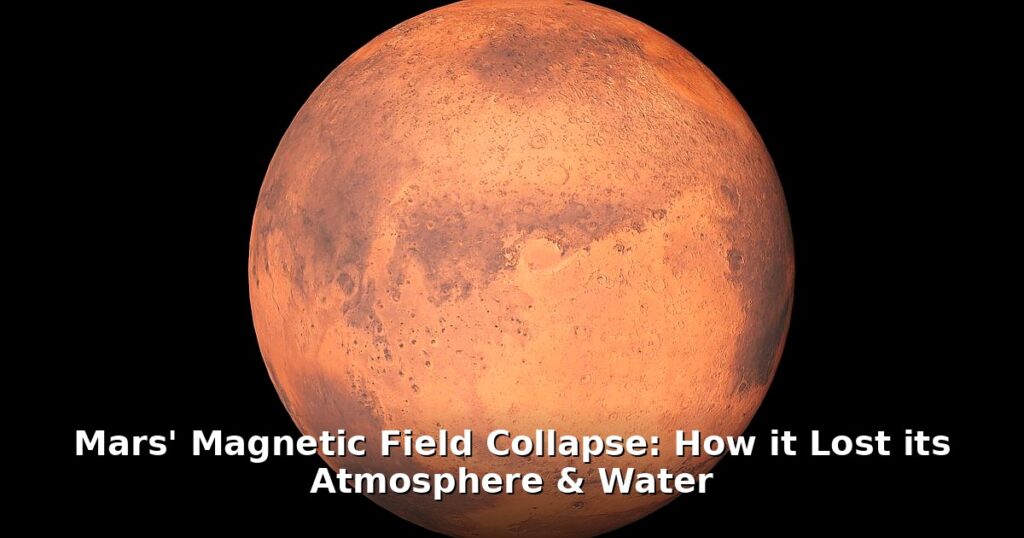

Imagine looking up at the night sky and seeing Mars, not as the desolate red dot we know, but as a vibrant, blue-green marble. Picture vast oceans shimmering under a thick atmosphere, clouds drifting by, and perhaps even rainfall. Sounds like science fiction, doesn’t it? But for a significant portion of its early history, Mars was very likely just that – a world brimming with liquid water, a far cry from the frozen desert it’s today. And the reason for this dramatic transformation, a story of planetary catastrophe, largely boils down to the Mars magnetic field collapse.
Table of Contents
- The Red Planet’s Former Glory: A World with Water
- Earth’s Shield: Why Our Magnetic Field is So Crucial
- The Martian Catastrophe: The Mars Magnetic Field Collapse
- From Oceans to Deserts: The Loss of Atmosphere and Water
- Lessons from Mars: Protecting Our Own Planet (and Dreams of the Future)
- Frequently Asked Questions
It’s a stark reminder of how fragile a planet’s habitability can be, and it makes you think twice about our own world. We often take Earth’s protective blanket for granted, but Mars’s journey from potentially life-sustaining to barren wasteland offers a chilling glimpse into what can happen when a planet loses its natural defenses.
The Red Planet’s Former Glory: A World with Water
When you look at images from Mars rovers like Perseverance or Curiosity, you can’t help but notice the tell-tale signs of water everywhere. We’re talking about dried-up riverbeds, deltas, and even shorelines that suggest the presence of enormous lakes and possibly even shallow oceans in Mars’s distant past. These aren’t just subtle hints; some of these features are massive, indicating long-term, significant water flow. Check out our guide on Cosmic Giants: The Giant Arc & Big Ring Challenging Our Universe. We covered this in New ‘Next-Door Neighbor’ Planet: Could It Be Habitable?.
Scientists have found a treasure trove of minerals on Mars that only form in the presence of liquid water. Clay minerals, sulfates, and carbonates – these are like ancient fingerprints, solid proof that water once flowed freely and extensively across the Martian surface. It’s not just a theory; the evidence is overwhelming.
For all that water to exist in liquid form, Mars needed a much thicker, warmer atmosphere than it has now. A dense atmosphere would have trapped heat, creating a greenhouse effect, and allowed water to remain stable at the surface. Think of it like Earth, but maybe a bit cooler and with a slightly different atmospheric composition. This early Mars wasn’t just wet; it was potentially habitable. It had the ingredients: liquid water, an atmosphere, and a source of energy from the sun. A truly fascinating picture.
Earth’s Shield: Why Our Magnetic Field is So Crucial
Before we delve deeper into Mars’s demise, let’s take a moment to appreciate what’s protecting us right now. Earth has this incredible, invisible shield called a magnetosphere, generated by its magnetic field. It’s truly our planet’s first line of defense against one of the most destructive forces in our solar system: the solar wind.
The solar wind is a constant stream of energetic, charged particles (mostly electrons and protons) ejected from the Sun’s upper atmosphere at incredibly high speeds. It’s powerful stuff, capable of stripping away a planet’s atmosphere layer by layer. Without a magnetic field, the solar wind would interact directly with our atmosphere, ionizing molecules and accelerating them into space. Not great.
Here’s the thing — So, where does our magnetic field come from? Deep inside Earth, we have a churning, molten outer core composed mainly of liquid iron and nickel. The convection currents within this electrically conductive fluid, coupled with Earth’s rotation, act like a giant dynamo, generating a powerful global magnetic field. It’s a complex process, but the outcome is vital: a strong magnetosphere that deflects most of the solar wind around our planet, allowing our atmosphere to remain largely intact and protecting life on the surface from harmful radiation.
If Earth were to lose its magnetic shield, the consequences would be catastrophic. Our atmosphere would gradually erode away, oceans would eventually boil off or freeze, and the surface would be bombarded with deadly radiation. Life as we know it would cease to exist. It’s a stark thought, and it really puts into perspective what Mars lost.
The Martian Catastrophe: The Mars Magnetic Field Collapse
So, what happened to Mars? Why did it lose its protective magnetic field? Scientists believe that early Mars, like Earth, also had a molten core that generated a global magnetic field. This field likely lasted for the first few hundred million years of the planet’s existence, shielding its nascent atmosphere and allowing for the presence of those ancient oceans.
But then, something changed. Mars is a smaller planet than Earth, and smaller planets tend to cool down faster. The prevailing theory is that Mars’s molten core began to cool and solidify much more quickly than Earth’s. As the core cooled, the convection currents that drove its internal dynamo gradually weakened and eventually ceased. Without these churning, electrically conductive fluids, the global magnetic field simply faded away. It was a planetary death knell.
You might not expect this, but This Mars magnetic field collapse is believed to have happened relatively early in the planet’s history, perhaps around 3.7 to 4 billion years ago. We don’t have a precise timeline, but the geological evidence suggests it was a geologically brief period over which the transformation occurred. Once that shield was gone, Mars was nakedly exposed to the relentless assault of the solar wind.
We even have direct evidence of this process happening today! NASA’s MAVEN (Mars Atmosphere and Volatile Evolution) mission has been orbiting Mars since 2014, specifically studying how the solar wind interacts with the Martian upper atmosphere. MAVEN has confirmed that the solar wind is indeed continuously stripping away the remaining thin atmosphere, like a cosmic sandblaster. It’s a slow process now, but it’s been happening for billions of years, gradually chipping away at what was left.
From Oceans to Deserts: The Loss of Atmosphere and Water
Once the Mars magnetic field collapse occurred, it was a domino effect. Without that protective magnetosphere, the powerful solar wind had a direct path to the Martian atmosphere. The energetic particles from the sun collided with atmospheric gases, imparting enough energy to literally kick molecules out into space. This process, known as atmospheric stripping, is the primary reason for the martian atmosphere loss.
Lighter elements like hydrogen and oxygen, which are components of water, were particularly vulnerable. Over vast stretches of time, billions of years, these crucial elements were systematically blasted away into the vacuum of space. Think of it like a leaky balloon, slowly deflating over eons. The planet couldn’t hold onto its air. No joke.
As the atmosphere thinned, two major things happened. First, the atmospheric pressure dropped dramatically. Liquid water can’t exist stably on the surface under such low pressure; it would either boil off (sublimate directly into gas) or freeze solid almost instantly. Second, with less atmosphere to trap heat, the planet’s surface temperature plummeted. What remaining surface water there was either sublimated away or froze into permafrost, locked away beneath the surface or in the polar ice caps.
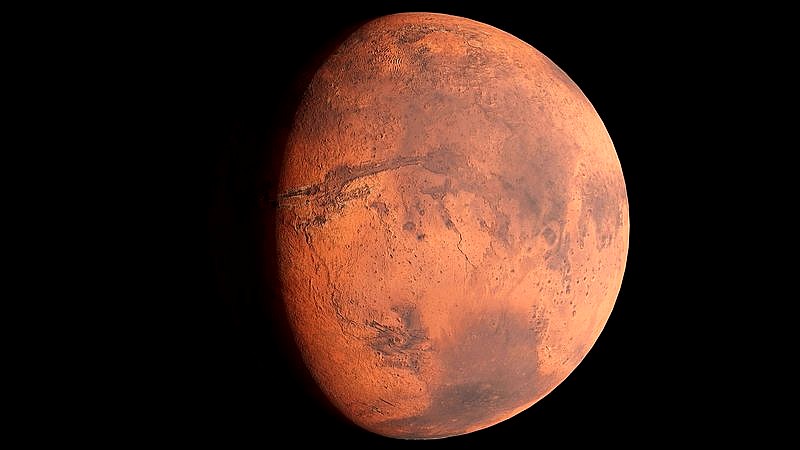
This is how Mars transformed from a potentially wet, warm, and habitable world into the frozen, arid desert we observe today. It’s a dramatic, irreversible change driven by the loss of its planetary shield. The planet’s once-thicker atmosphere gave way to a wispy veil of mostly carbon dioxide, incapable of sustaining liquid water or supporting complex life as we know it.
Lessons from Mars: Protecting Our Own Planet (and Dreams of the Future)
The story of Mars serves as a profound lesson about planetary habitability. It unequivocally demonstrates the critical importance of a global magnetic field for a planet to retain its atmosphere and, by extension, its surface water over geological timescales. Without that shield, even a world with all the right initial ingredients can become a desolate wasteland. This insight is incredibly valuable as we search for exoplanets that might host life beyond our solar system. When astronomers assess potential habitability, the presence (or evidence of past presence) of a strong magnetic field is a huge factor. Just something to think about.
Understanding Mars’s past also informs our future ambitions. Scientists continue to study Mars not just to understand its history, but also to inform potential future human missions. Knowing how the Mars magnetic field collapse changed the planet helps us prepare for long-duration stays, considering radiation exposure and resource availability.
And then there’s the truly ambitious, almost fantastical idea of terraforming Mars. Could we ever, in the distant future, give Mars an atmosphere back? Could we somehow recreate a magnetic field? Some speculative concepts involve placing giant magnetic shields at the L1 Lagrangian point between Mars and the Sun to deflect the solar wind, effectively creating an artificial magnetosphere. This would then allow an atmosphere to slowly rebuild, potentially warming the planet and allowing liquid water to return. It’s a colossal undertaking, a monumental feat of engineering, and currently far beyond our capabilities. But the thought alone is inspiring, human ingenuity and our enduring fascination with our red neighbor. A lot to unpack there.
For now, Mars remains the power of cosmic forces and a powerful reminder to appreciate the unique, life-sustaining conditions we enjoy here on Earth. Our magnetic field isn’t just a curiosity; it’s our planet’s lifeblood.
Frequently Asked Questions
Q: Did Mars ever have a strong magnetic field?
A: Yes, scientific evidence suggests that early Mars had a global magnetic field, similar to Earth’s, which protected its atmosphere and allowed for the presence of liquid water on its surface. This field was crucial for its potential habitability.
Q: What caused Mars’ magnetic field to collapse?
A: Scientists believe Mars’ internal dynamo, driven by its molten core, gradually shut down. This could be due to the planet cooling down and its core solidifying, which stopped the convection currents necessary to generate a strong magnetic field.
Q: How did Mars lose its atmosphere?
A: Once its protective magnetic field collapsed, Mars’ atmosphere was directly exposed to the sun’s powerful solar wind. Over time, these energetic particles stripped away the atmospheric gases, causing the planet to lose most of its air and surface water.
Q: Could Mars get its magnetic field back?
A: It’s highly unlikely Mars could naturally regain its magnetic field, as its core is believed to be mostly solid and cooled. There are theoretical, highly speculative ideas about artificially creating a magnetosphere, but these are far beyond current technological capabilities.