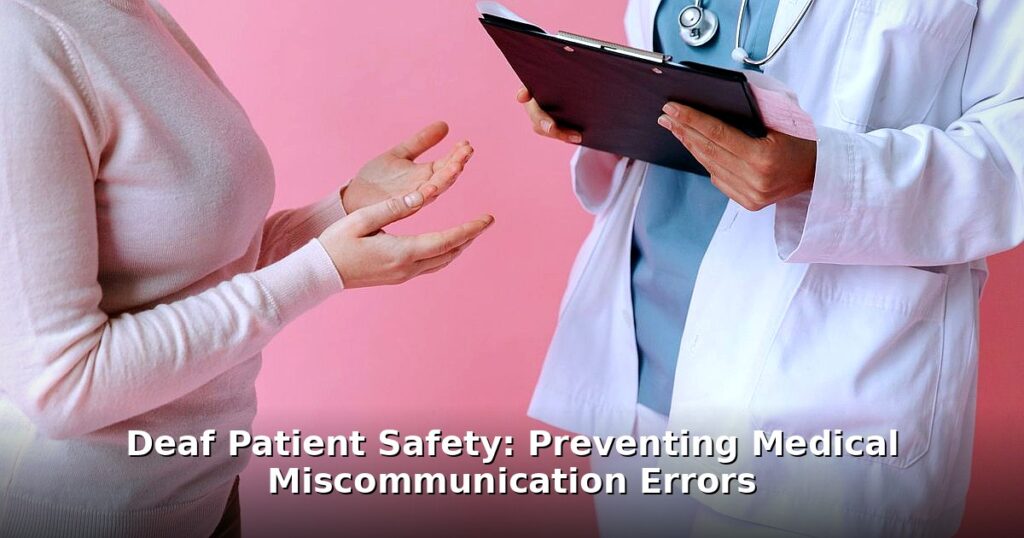

It’s truly unsettling to hear stories where the very systems meant to protect and heal us fall short, especially something as fundamental as communication. Recently, news broke about a deaf patient in the UK who was reportedly given the wrong vaccination jab due to a critical sign language interpretation error. The detail that really stuck with me? Funny enough, the interpreter allegedly confused “flu” with “COVID-19” during the interaction. A simple misunderstanding? Perhaps, but one with potentially serious implications for that individual’s health. This incident, while specific, shines a glaring spotlight on the broader issue of deaf patient safety and the absolute necessity of precise communication in healthcare.
Table of Contents
Think about it: every single medical encounter, from a routine check-up to an emergency room visit, hinges on an accurate exchange of information. You need to tell your doctor what’s bothering you, and they need to clearly explain diagnoses, treatment options, and medication instructions. There’s no room for ambiguity when your health is on the line. And yet, for many deaf individuals, this basic premise of clear, effective communication is often a luxury, not a given.
I’ll be honest — The stakes are incredibly high. A miscommunication can lead to wrong diagnoses, incorrect medication dosages, missed appointments, or even refusal of necessary treatment because the patient simply doesn’t understand what’s happening or why. These aren’t just minor inconveniences; they can be life-altering, even life-threatening, consequences. It’s a stark reminder that healthcare isn’t just about medicine; it’s about people, and people need to connect and understand each other. No joke. Check out our guide on Lyme Disease Ticks Spreading in NC: What You Need to Know Now. We covered this in DR Congo’s Deadliest Ebola Outbreak: Understanding the Crisis.
Understanding Communication Barriers for Deaf Patients
Here’s the thing — When we talk about deaf patients in medical settings, it’s easy to focus solely on the language barrier. But the reality is far more complex. Imagine walking into a doctor’s office, already feeling vulnerable, and then facing a gauntlet of additional challenges that hearing individuals rarely consider. It’s not just about English versus British Sign Language or American Sign Language.
Real talk: For one, there’s the critical difference between a professional sign language interpreter and an ad-hoc solution. Often, hospitals, under pressure or simply uneducated on best practices, will rely on family members or friends to interpret. While well-intentioned, this is fraught with problems. Family members might not know medical terminology, they might inadvertently filter or sugarcoat information, or they might become emotionally distressed by the content, impacting their ability to interpret accurately. They also lack the impartiality of a professional.
Then there are the environmental factors. Hospitals are noisy places. Alarms, intercoms, conversations – it’s a constant din. For someone who relies on visual communication, this can be incredibly distracting and make concentration difficult. And let’s not forget masks! In our post-pandemic world, masks are everywhere, and while essential for infection control, they completely obscure lips, making lip-reading impossible for those who rely on it. A quick chat with a masked nurse can become an insurmountable hurdle. Time constraints, too, play a role. Doctors are busy, often rushing from patient to patient, and the time it takes for a full, accurate interpretation can feel like an added burden, even though it’s absolutely necessary for patient safety.
These factors combine to create a perfect storm where medical communication errors can flourish. It’s not usually malicious; it’s often a systemic oversight, a lack of understanding, or simply insufficient resources dedicated to healthcare accessibility for deaf individuals.
Protecting Deaf Patient Safety: Best Practices for Healthcare Providers
Okay, so So, what can be done? A lot, actually. Ensuring deaf patient safety isn’t some insurmountable challenge; it requires a commitment to best practices and a willingness to invest in proper resources. Healthcare facilities have a responsibility to create an inclusive environment, and there are concrete steps they can take.
First and foremost, mandatory professional interpreter services. This isn’t optional; it’s a necessity and a legal right in many places, including under the Americans with Disabilities Act (ADA) in the United States. Hospitals should have clear, well-publicized policies for requesting interpreters, and staff should be trained on how to access these services quickly and efficiently. This includes both in-person and video remote interpreting (VRI) options, though VRI should be used judiciously and only when appropriate, not as a blanket replacement for in-person interpreters.
Staff training is another crucial component. It’s not enough to just have interpreters available; the entire medical team needs to understand deaf culture and communication best practices. This means learning how to interact directly with the patient (not just the interpreter), maintaining eye contact, speaking clearly and at a normal pace, and understanding that sign language isn’t simply a word-for-word translation of spoken language. I’ve even heard of some hospitals encouraging basic sign language phrases for front-line staff – a small gesture that can build huge bridges of trust.
Visual aids and written instructions are incredibly helpful. A picture really can be worth a thousand words, especially when explaining complex medical procedures or anatomy. Providing written summaries of diagnoses, treatment plans, and medication instructions in plain language can reinforce what’s been discussed and give patients something to refer back to later. And then there’s the “teach-back” method: asking the patient to explain in their own words what they’ve understood. This is a powerful way to confirm comprehension and catch any misunderstandings before they become problems. It’s a practice that benefits all patients, honestly, but is particularly vital for those with communication barriers.
On a system level, hospitals need to ensure that interpreter availability isn’t just a promise, but a reality. This means adequate budgeting, partnerships with reputable interpreting agencies, and perhaps even having in-house interpreters for larger facilities. Quality assurance for interpreters is also key – they should be certified and experienced in medical settings. It’s an investment, yes, but one that pays dividends in patient outcomes, reduced errors, and increased trust.
Advocacy and Empowerment: What Deaf Patients Can Do
While the onus is largely on healthcare providers to improve, deaf individuals and their families also play a vital role in advocating for their own needs. It can feel daunting to assert yourself in a medical setting, but it’s absolutely essential for preventing medical mistakes and ensuring you receive the care you deserve.
My advice? Be proactive. Don’t wait for the hospital to offer an interpreter. Request one as soon as you schedule an appointment, and then confirm that request multiple times before the visit. When you arrive, reiterate your need. If a professional interpreter isn’t provided, and a family member is suggested, you have the right to decline that. Insist on a qualified, impartial interpreter. The National Association of the Deaf (NAD) is a fantastic resource, providing information on your rights and how to advocate for them. You can find more information on their website: NAD: Your Right to an Interpreter.
Come prepared to your appointments. Write down your symptoms, questions, and concerns beforehand. This can help streamline communication even with an interpreter present. And don’t be afraid to ask for things in writing – summaries, instructions, anything that will help you remember and understand. It’s your health, and you have every right to ensure you’re fully informed.
Look, And here’s a big one: document, document, document. If you encounter communication barriers or feel your requests for an interpreter are being ignored, make a note of it. Who did you speak to? When? What was their response? This kind of documentation can be incredibly important if you need to file a complaint or pursue further action to ensure your patient advocacy for deaf individuals is heard and respected. It’s not about being confrontational; it’s about ensuring accountability and ultimately, better care for everyone.
Moving Forward: Building a More Inclusive Healthcare System
Here’s the thing — The incident with the wrong jab is more than just an unfortunate isolated event; it’s a symptom of broader issues within our healthcare system regarding equity and accessibility. It highlights a gap that needs urgent attention. When a significant portion of the population faces systemic barriers to receiving basic medical care, we’re failing to uphold the fundamental principle of “do no harm.”
We need ongoing research into effective communication strategies and patient outcomes for deaf individuals. We need stronger policies that aren’t just recommendations, but mandates, with clear enforcement mechanisms. And critically, we need better education for everyone in healthcare, from the receptionists to the top administrators, about the unique needs and rights of deaf patients.
I often think about how my own habits contribute to my health, and it’s usually the small, consistent things that make the biggest difference. The same goes for building a truly inclusive healthcare system. It’s not about one grand gesture, but a multitude of small, consistent changes: a staff member learning a few signs, a hospital investing in VRI technology, a doctor taking an extra five minutes to ensure comprehension. These seemingly small actions accumulate to foster trust, reduce medical communication errors, and ultimately, build a much safer and more equitable environment for all patients. And really, isn’t that what healthcare should always be about?
Frequently Asked Questions
Q: What are common communication barriers for deaf patients in healthcare?
A: Deaf patients often face challenges like lack of professional sign language interpreters, reliance on untrained family members, and difficulties with lip-reading due to masks or poor lighting. This can lead to misunderstandings and medical errors.
Q: How can hospitals improve communication with deaf patients?
A: Hospitals can improve by providing qualified sign language interpreters, training staff on deaf culture and communication best practices, and using visual aids and written materials. Ensuring accessibility is key to patient safety.
Q: What rights do deaf patients have regarding communication in medical settings?
A: Deaf patients generally have the right to effective communication under laws like the Americans with Disabilities Act (ADA), which includes access to qualified interpreters or other auxiliary aids. They should advocate for these rights.
Q: Can a family member interpret for a deaf patient?
A: While family members may offer to interpret, it’s generally not recommended for medical situations due to potential biases, emotional strain, and lack of professional medical terminology knowledge. A qualified, impartial interpreter is usually preferred for accurate communication.