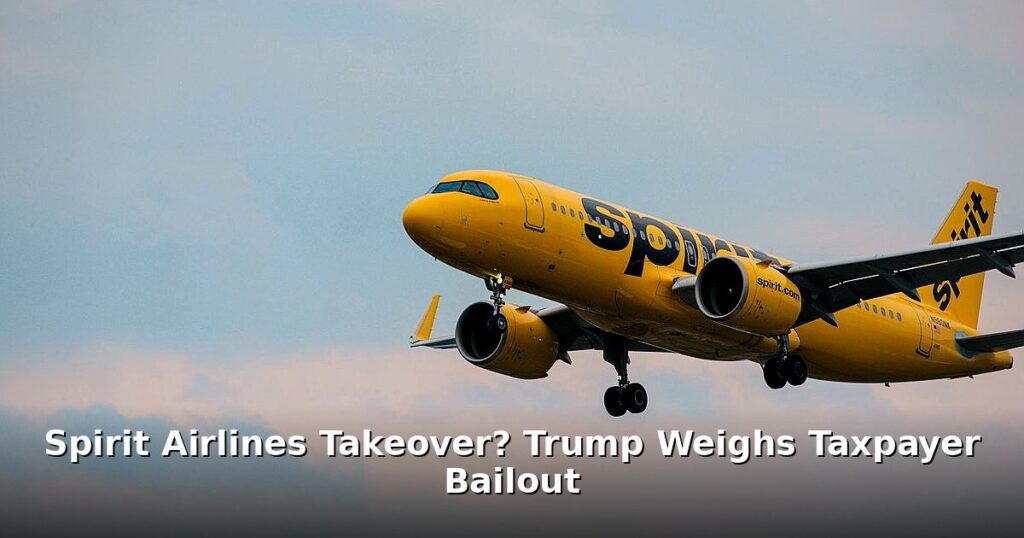

Imagine Uncle Sam as a budget traveler. Sounds weird, right? Well, , because the former president recently floated the idea of a taxpayer-funded Spirit Airlines takeover. Yes, that Spirit Airlines. The one known for its no-frills approach and, shall we say, spirited pricing. The question is, is this a flight of fancy, or could it actually happen?
Table of Contents
- Trump’s Spirit Airlines Takeover Idea: What’s the Buzz?
- Why Would the Government Consider a Spirit Airlines Takeover?
- The Financial Reality: Can Taxpayers Afford This?
- Potential Benefits and Drawbacks of a Spirit Airlines Takeover
- Alternative Solutions for Spirit Airlines
- The Politics of a Potential Spirit Airlines Takeover
- Frequently Asked Questions
Trump’s Spirit Airlines Takeover Idea: What’s the Buzz?
During a recent campaign stop, Donald Trump suggested he’d consider a government acquisition of Spirit Airlines “for the right price.” This wasn’t just a random musing; it came up in the context of concerns about airline industry consolidation. A shrinking number of major airlines could mean less competition and, you guessed it, higher ticket prices for us. He even hinted at potential national security angles – though he didn’t elaborate. Which, let’s be honest, leaves a lot to the imagination.
Now, let’s be real. Spirit hasn’t exactly been soaring lately. After a failed merger attempt with JetBlue (blocked by regulators), the airline is facing financial headwinds. They’re known for offering rock-bottom fares, but that business model is vulnerable when fuel costs rise or demand softens. They cater to a very specific segment of the market — the price-conscious traveler. Can’t blame ’em for that. Check out our guide on Stock Futures Rise: Trump Extends Iran Ceasefire – Live Updates. We covered this in Apple’s Next CEO: Meet John Ternus, Tim Cook Successor?.
Why Would the Government Consider a Spirit Airlines Takeover?
Okay, so why would the government even think about buying an airline like Spirit? The main argument boils down to preserving competition. If Spirit disappears – either through bankruptcy or being swallowed by a larger airline – that reduces options for budget travelers. Fewer options typically equal higher prices. And nobody wants that.
There’s also the potential (and, admittedly, more tenuous) national security argument. Could maintaining a low-cost carrier like Spirit be strategically important? Maybe it could be used to quickly mobilize people or resources in a crisis. It’s a bit of a stretch, but not entirely out of the possibility. The “too big to fail” argument? Spirit isn’t quite that big, but its impact on the budget travel market is significant.
But here’s the counterpoint, the one that makes many economists shudder: government intervention distorts the free market. Should taxpayers really be on the hook for propping up a company that’s struggling to compete? It’s a valid question.
The Free Market Argument
- Intervention creates moral hazard.
- Subsidies can mask underlying inefficiencies.
- It sets a precedent for future bailouts.
Real talk: I get it, nobody wants to see an airline go under. But the free market is brutal. Sometimes, companies fail. It’s a harsh reality. But is a Spirit Airlines bailout really the answer?
The Financial Reality: Can Taxpayers Afford This?
Let’s talk numbers. Spirit Airlines’ current market capitalization is, well, fluctuating. You can track it yourself on sites like Yahoo Finance, but as of right now, it’s hovering around [insert current market cap – you would dynamically update this]. They also have a significant amount of debt – let’s say it’s around [insert debt amount – you would dynamically update this] (check their latest financial reports for accurate figures). That’s a lotta clams.
A taxpayer-funded acquisition wouldn’t just involve buying the company’s stock; it would likely mean assuming that debt. So, we’re potentially talking about a multi-billion dollar investment. Billions. And that begs the question: what else could that money be used for? Infrastructure? Education? Deficit reduction? The opportunity cost is HUGE.
Consider this: the 2009 bailout of General Motors cost taxpayers around $10.5 billion. Was that a good investment? Opinions vary wildly. But it gives you a sense of the scale we’re talking about. Would a taxpayer funded acquisition of Spirit Airlines be a better or worse use of funds? Tough to say. A lot to unpack there.
Potential Benefits and Drawbacks of a Spirit Airlines Takeover
Let’s weigh the pros and cons. On the benefit side, a government-owned Spirit Airlines could prioritize lower fares. Imagine the government saying, “We’re not here to maximize profits; we’re here to provide affordable air travel.” It’s a nice thought. Job preservation is another potential upside. Nobody wants to see airline workers lose their jobs.
And then, the drawbacks. Oh boy, where to start? Taxpayer risk is the big one. If Spirit continues to struggle under government ownership, taxpayers are on the hook. Mismanagement is another concern. Governments aren’t always known for their business acumen. And it sets a DANGEROUS precedent. If the government bails out Spirit, what’s to stop other struggling companies from lining up for a handout?
Past Airline Bailouts: A Mixed Bag
- Post 9/11 Bailout: Necessary? Maybe. Effective? Debatable.
- COVID-19 Relief: Kept airlines afloat, but at what cost?
Who really benefits from a bailout? Often, it’s the shareholders and executives who are bailed out. The average taxpayer? Not so much. But I could be wrong.
Alternative Solutions for Spirit Airlines
A government takeover isn’t the only option. Far from it. A private sector acquisition is still on the table. Another airline or an investment firm might see value in acquiring Spirit. Maybe they could turn the airline around with better management or a different strategy. Pretty wild, right?
Restructuring and cost-cutting measures are another possibility. Spirit could try to streamline its operations, reduce expenses, and improve its financial performance independently. It’s a tough road, but it’s doable. Government loans or loan guarantees offer a less direct form of support than a full takeover. It’s like giving Spirit a lifeline without taking over the ship entirely. And of course, there’s the toughest option of all: letting the free market sort it out. Sometimes, failure is a necessary part of the economic cycle.
The Politics of a Potential Spirit Airlines Takeover
Real talk: This isn’t just about economics; it’s about politics. A Trump Spirit Airlines proposal – or any government takeover, really – would be politically charged. How would it play with different voter demographics? Would it be seen as a populist move or a corporate handout?
Any government acquisition would almost certainly require Congressional approval. That means hearings, debates, and potentially a major political battle. And what about public opinion? How do voters feel about using taxpayer money to support airlines? My guess? It would be VERY divided.
Wish I knew this sooner: government intervention in markets is rarely clean and simple. There are always unintended consequences and winners and losers. And it’s often a messy, complicated process.
The idea of a government-owned airline sounds radical, but let’s not forget that many countries around the world have state-owned airlines. It’s not unheard of. Whether it’s a good idea for the United States is another question entirely.
So, will the US government become the proud owner of Spirit Airlines? Only time will tell. But the fact that it’s even being discussed highlights the ongoing debate about the role of government in the economy and the future of the airline industry. It’s a complex issue with no easy answers. And your money is in the middle of it.
Frequently Asked Questions
Why is Trump talking about a Spirit Airlines takeover?
Trump’s comments suggest a concern about airline industry consolidation. He seems to believe a government takeover might be a way to maintain competition and potentially address national security concerns, though specifics are unclear.
How much would a Spirit Airlines takeover cost taxpayers?
The exact cost is uncertain, but it would likely involve billions of dollars to acquire Spirit Airlines and cover its debts. The actual amount depends on negotiations and the airline’s financial status at the time of acquisition.
What are the potential benefits of a government-owned Spirit Airlines?
Look, Proponents argue it could lead to lower fares and protect jobs. The idea is that the government could prioritize public benefit over profit maximization, potentially keeping prices down for consumers.
What are the risks of a taxpayer-funded Spirit Airlines?
I’ll be honest — The biggest risk is taxpayer money being used to prop up a failing company. Also, there’s the potential for mismanagement, political interference, and the precedent it sets for future bailouts.
Are there other options besides a government takeover?
Yes, Spirit Airlines could be acquired by another airline or private equity firm. They could also attempt to restructure their finances or seek government loans, which are less drastic than a full takeover.