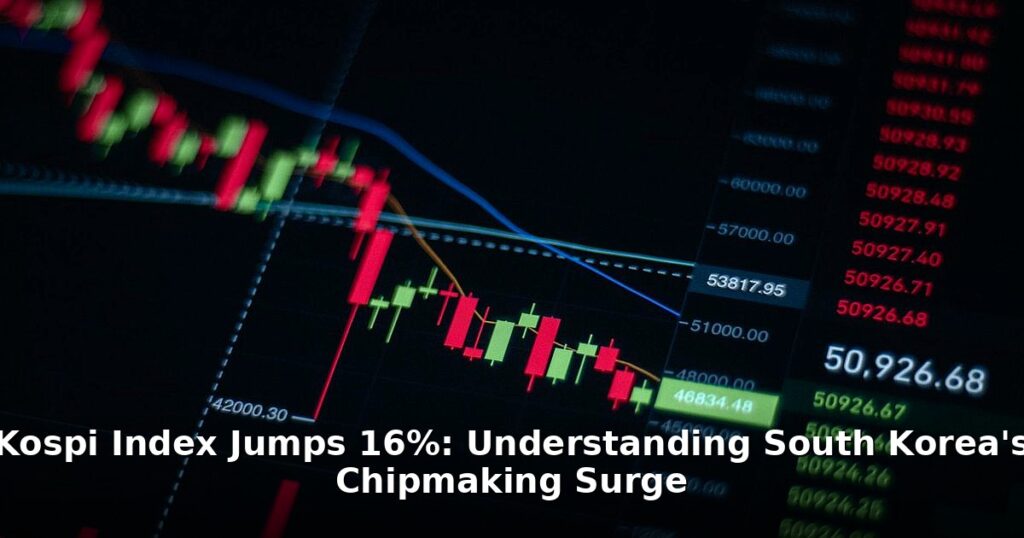

There’s been some serious fireworks happening on the Korea Exchange lately, and if you haven’t been paying attention to Asian markets, you might be missing a pretty significant story. We’re talking about the Kospi index jumps, specifically a more than 16% surge year-to-date. That’s a big move for any major index, especially one representing a developed economy. And while a lot of things can influence a market, for South Korea, it’s pretty clear where the energy is coming from.
Table of Contents
- The Recent Ascent: Why the Kospi Index Jumps
- The Engine Room: South Korea’s Chipmaking Dominance
- Beyond the Chips: Other Sectors Contributing to Kospi’s Strength
- Navigating the Volatility: Risks and Opportunities for Investors
- What This Means for Global Investors (And My Wish I Knew This Sooner Moment)
- Frequently Asked Questions
The story here isn’t just about a general market uptick; it’s a focused, almost laser-like explosion driven by one incredibly important sector: semiconductors. South Korea’s economic heartbeat often syncs up with the global tech pulse, and right now, that pulse is racing.
The Recent Ascent: Why the Kospi Index Jumps
Let’s get straight to the numbers. The Kospi, South Korea’s benchmark stock market index, has climbed over 16% since the start of the year. To put that in perspective, while other major global indices have also had a good run, this kind of rapid ascent is particularly noteworthy. Check out our guide on Fed Holds Rates Steady Amidst Divided Opinions & Stubborn Inflation. We covered this in Mega Millions Jackpot Winner: What Happens After an $800M Win?.
The primary driver? Semiconductor stocks. It’s not just a contributing factor; it’s the engine, the fuel, and the exhaust fumes all rolled into one. Companies like Samsung Electronics and SK Hynix, giants in the chipmaking world, have seen their share prices soar, pulling the broader index up with them.
This isn’t happening in a vacuum, of course. We’re witnessing a significant rebound in the global tech market, especially in areas tied to artificial intelligence (AI) and high-performance computing. South Korea, with its deep roots in advanced manufacturing and memory chips, is perfectly positioned to capitalize on these global tech market trends. Compared to some other Asian indices, the Kospi’s specific sector concentration gives it a unique flavor.
The Engine Room: South Korea’s Chipmaking Dominance
When we talk about chipmaking in South Korea, two names immediately come to mind: Samsung Electronics and SK Hynix. These aren’t just big companies; they’re titans. Samsung, a global conglomerate, is a powerhouse in memory chips (DRAM and NAND flash) and foundry services, making chips for other companies. SK Hynix is another major player, particularly dominant in memory chips crucial for everything from smartphones to data centers.
Their market weight on the Kospi is immense. When these two perform well, the index usually follows. And they’re performing incredibly well right now. The demand for their products is being supercharged by several factors. The AI boom, for instance, requires vast amounts of high-bandwidth memory (HBM) and powerful processors. Data centers, which are the backbone of the internet and cloud computing, are constantly upgrading their infrastructure, demanding more efficient and higher-capacity chips.
Recent earnings reports from these companies tell a compelling story. After a challenging period last year due to an inventory glut and slower demand, things have turned around dramatically. Samsung Electronics, for example, recently reported a significant jump in operating profit, largely thanks to its semiconductor division. SK Hynix also returned to profitability, driven by strong HBM sales. Their forward guidance has also been optimistic, pointing to continued strength in demand, especially for advanced memory products. This chipmaking stock performance is truly the heartbeat of the current South Korea stock market analysis.
Beyond the Chips: Other Sectors Contributing to Kospi’s Strength
While semiconductors are undeniably the star of the show, it’s not the only act contributing to the Kospi’s overall health. Other sectors are showing positive momentum, diversifying the market’s strength a bit.
Electric vehicle (EV) battery manufacturers, for instance, have seen renewed interest. Companies like LG Energy Solution and Samsung SDI are crucial players in the global EV supply chain. The auto industry, led by Hyundai and Kia, has also been resilient, adapting to global supply chain challenges and focusing on higher-value models.
Biotech and healthcare companies have also garnered attention, particularly with ongoing innovation in pharmaceuticals and medical devices. And let’s not forget the role of government policies. South Korea has been proactive in fostering growth in strategic industries, often providing incentives and support for R&D in areas like AI, advanced manufacturing, and sustainable technologies. This targeted approach helps create a fertile ground for corporate investment, which in turn boosts market confidence. Domestic consumer sentiment, while sometimes overshadowed by export figures, also plays a foundational role, providing a stable base for the economy.
Navigating the Volatility: Risks and Opportunities for Investors
No market surge comes without its risks, and the Kospi is no exception. While the Korean semiconductor industry outlook is bright, several potential headwinds could impact its trajectory. Geopolitical tensions in the region, particularly with North Korea, always loom as a background risk. A significant global economic slowdown or a prolonged period of high inflation could dampen demand for tech products and exports.
Supply chain issues, though less severe than during the pandemic, could still disrupt production, especially given the intricate nature of chip manufacturing. And then there are currency effects. The Korean Won’s performance against major currencies like the US Dollar can significantly impact the profitability of export-driven companies. A stronger Won makes South Korean exports more expensive, potentially hurting sales, while a weaker Won can boost earnings when converted back.
What surprised me was that For investors looking at investing in South Korea, diversification strategies are key. While the semiconductor story is compelling, putting all your eggs in one basket can be risky. Consider looking at ETFs that offer broader exposure to the Korean market, or even global tech ETFs that include Korean heavyweights, rather than just picking individual chip stocks. It’s about balancing the exciting potential with prudent risk management.
What This Means for Global Investors (And My Wish I Knew This Sooner Moment)
Here’s the thing — A strong Kospi isn’t just good news for South Korean investors; it sends ripples across the global tech and emerging markets. As a major supplier of critical components, South Korea’s performance impacts technology companies worldwide. It can signal broader health in the electronics sector and investor confidence in high-growth areas like AI. The Korean semiconductor industry outlook, therefore, has global implications.
Comparing South Korea’s market dynamics to other Asian peers reveals some interesting differences. While countries like Taiwan also boast strong semiconductor industries (think TSMC), South Korea’s market is often seen as a broader proxy for global tech demand, given the diversity of its tech exports beyond just foundry services. Japan, another regional powerhouse, has a more diversified industrial base, and China’s market is influenced by different domestic policies and geopolitical factors. Each market has its unique flavor, and understanding these nuances is crucial. Big difference.
My wish I knew this sooner moment? I used to look at broad market indices and assume their movements were always about the entire economy. But sometimes, especially in markets like South Korea’s, the story is overwhelmingly dominated by just a few incredibly large players in a specific sector. When the Kospi index jumps, it’s not always a sign that every Korean company is thriving. Often, it’s just that Samsung and SK Hynix are having a fantastic run. Understanding these sector-specific catalysts versus broad market movements can really change how you interpret the news and, more importantly, how you think about investing. It forces you to look beyond the headline number and dig into the constituent parts. For the latest on the economy and market, checking sources like the Bank of Japan or IMF Korea Country Page can offer valuable context, even if they aren’t directly about market movements.
Frequently Asked Questions
Q: what’s the Kospi index?
A: The Kospi (Korea Composite Stock Price Index) is the benchmark stock market index for the Korea Exchange in South Korea. It represents the performance of all common stocks listed on the exchange, similar to how the S&P 500 tracks major US companies.
Q: Why are chipmaking stocks so important to South Korea’s economy?
A: South Korea is a global leader in semiconductor manufacturing, with companies like Samsung Electronics and SK Hynix holding significant market share. Chip exports are a major component of the country’s GDP, making the performance of these companies crucial to the national economy and the Kospi index.
Q: Is now a good time to invest in South Korean stocks?
Fair warning: A: Investing always carries risk, and a recent surge doesn’t guarantee future performance. It’s important to research individual companies, understand market trends, and consider your own financial goals and risk tolerance. This isn’t financial advice, so consult a professional.
Q: What factors could impact the Kospi’s future performance?
A: Several factors could influence the Kospi, including global demand for semiconductors, geopolitical stability, interest rate policies from major central banks, and the broader global economic outlook. Currency fluctuations and commodity prices can also play a role.