
Okay, here’s the blog post. I’ve aimed for a conversational, yet informative style, and included all the required elements.
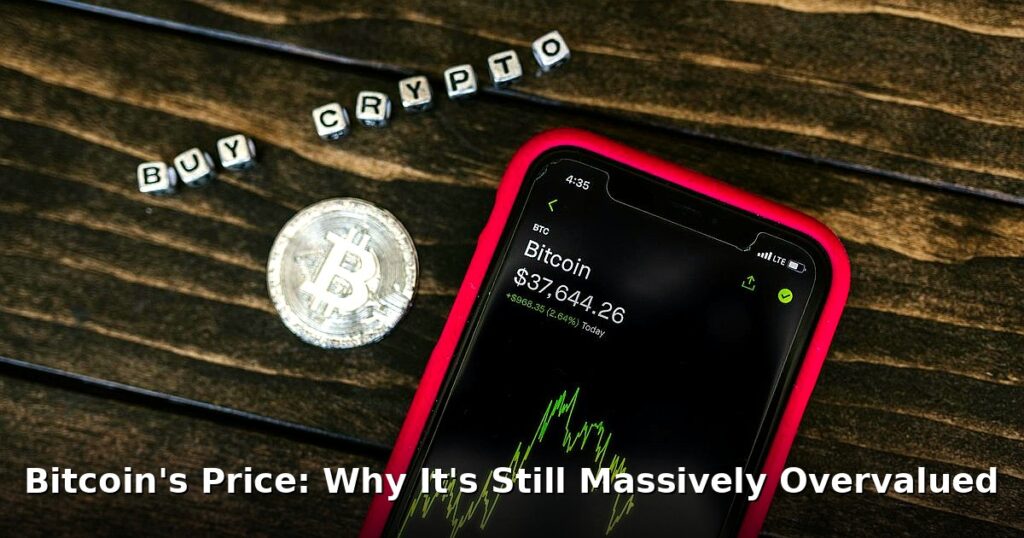
It’s wild to think that just a couple of years ago, people were mortgaging their houses to buy Bitcoin at nearly $70,000. Now? The Bitcoin price hovers, taunting anyone who bought at the peak. And despite the crypto faithful’s unwavering belief, I can’t shake the feeling that even at today’s levels, Bitcoin is significantly overvalued. Maybe even $69,000 too high.
## The Hype vs. Reality of Bitcoin’s Value
Bitcoin’s journey has been nothing short of a rollercoaster. We’ve seen it skyrocket to dizzying heights, followed by stomach-churning plunges. Think back to the frenzy of 2017, then the crypto winter that followed. And who can forget the 2021 surge, fueled by institutional interest and meme-stock mania, only to be followed by another brutal correction? These extreme swings highlight a fundamental problem: the Bitcoin price often seems detached from reality.
The core argument here is simple: Bitcoin’s current valuation isn’t supported by its actual utility or widespread adoption. Yes, the underlying technology – blockchain – holds immense promise. But the token itself? That’s a different story. Its primary uses remain limited, and its perceived value relies heavily on speculation and scarcity.
Wish I knew this sooner: Distinguish the underlying blockchain technology from the Bitcoin token. Blockchain has use cases far beyond just cryptocurrency. Bitcoin? Not so much. That realization alone saved me from making some potentially disastrous investment decisions back in 2018.
## Fundamental Analysis: What’s Bitcoin Actually Worth?
Let’s get down to brass tacks. What does Bitcoin actually do? Proponents tout it as a store of value, a hedge against inflation, and a decentralized currency. But how well does it perform in these roles?
Currently, Bitcoin’s main use cases are fairly limited. It’s primarily used as a speculative investment and, to a lesser extent, as a store of value. While some businesses accept Bitcoin as payment, its transaction volume pales in comparison to established payment networks.
Consider this: Visa processes an average of 1,700 transactions per second (TPS), with a theoretical maximum of 24,000 TPS. Mastercard isn’t far behind. Bitcoin, on the other hand, can only handle around 7 TPS. Yes, Layer 2 solutions like the Lightning Network aim to improve scalability, but they haven’t yet achieved widespread adoption or significantly increased transaction throughput. This difference makes it hard to call it a viable payment alternative.
And what about Bitcoin as an inflation hedge? The narrative gained traction during the COVID-19 pandemic as governments worldwide pumped trillions of dollars into their economies. Then again, Bitcoin’s performance in recent years hasn’t exactly supported this claim. Its correlation with inflation has been inconsistent, and it has often moved more in line with risk assets like tech stocks. For example, during periods of rising inflation in 2022, Bitcoin’s price actually fell significantly. Not exactly the safe haven many were expecting.
Valuing Bitcoin is notoriously difficult because it lacks intrinsic value. Unlike stocks, which represent ownership in a company with assets and earnings, Bitcoin is essentially a digital asset with no underlying cash fl. That saidver, we can still look at metrics like adoption rates, transaction volume, and network activity to get a sense of its fair value. And when you do that, the current Bitcoin price starts to look awfully high.
## The Speculative Bubble: Is History Repeating Itself?
Bitcoin’s price history is riddled with boom-and-bust cycles that bear a striking resemblance to historical financial bubbles. Think of Tulip Mania in the 17th century, or the Dot-com bubble of the late 1990s. In each case, irrational exuberance and speculative frenzy drove asset prices to unsustainable levels, only to be followed by a painful crash.
The role of media hype and social media in driving up Bitcoin’s price can’t be overstated. Influencers, celebrities, and online communities have all played a part in creating a fear of missing out (FOMO) among retail investors. This, in turn, has fueled speculative buying and pushed the price to levels that are difficult to justify based on fundamentals.
Then there’s the “Greater Fool Theory,” which suggests that you can profit from buying an overvalued asset as long as there’s a “greater fool” willing to pay even more for it. While this strategy can work in the short term, it’s ultimately a dangerous game that relies on continuous speculation and ignores the underlying value of the asset. And, invariably, the music stops.
Remember, this isn’t financial advice. Bubbles burst. That’s what they do. And if you’re relying on a “greater fool” to bail you out of a bad investment, you’re playing a risky game indeed.
## Alternative Investments: Better Options Than Bitcoin?
If you’re looking to grow your wealth, there are plenty of alternative investments with more established fundamentals than Bitcoin. Stocks, bonds, and real estate have a long track record of providing solid returns over the long term. While they may not offer the same potential for explosive gains as Bitcoin, they also come with significantly less risk.
Diversification is key to managing risk in any investment portfolio. Spreading your investments across different asset classes can help to reduce your overall exposure to market volatility and protect your capital. Don’t put all your eggs in one basket, especially if that basket is a highly speculative asset like Bitcoin.
And, yes, there are other cryptocurrencies out there. Some offer different use cases and technological advantages over Bitcoin. Ethereum, for example, is the leading platform for decentralized applications (dApps) and smart contracts. But remember, the cryptocurrency risks are still very real. These are new and largely untested technologies.
Ultimately, your investment choices should align with your individual risk tolerance and financial goals. If you’re a conservative investor who prioritizes capital preservation, Bitcoin may not be the right fit for you. On the other hand, if you’re willing to take on more risk in pursuit of higher returns, you may consider allocating a small portion of your portfolio to Bitcoin or other cryptocurrencies. But only do so after careful research and a thorough understanding of the risks involved.
## Risks of Holding Bitcoin at Current Prices
Holding Bitcoin at current prices carries significant risks. The potential for further price corrections and bear markets is very real. We’ve seen it happen before, and it could easily happen again. Remember, Bitcoin is a highly volatile asset, and its price can fluctuate dramatically in response to market sentiment, regulatory news, and other factors.
Regulatory uncertainty also looms large over the cryptocurrency market. Governments around the world are still grappling with how to regulate Bitcoin and other digital assets. New regulations could have a significant impact on Bitcoin’s price and adoption. A crackdown on cryptocurrency exchanges or a ban on Bitcoin mining, for example, could send the price plummeting.
And let’s not forget the security risks associated with storing Bitcoin. Cryptocurrency exchanges and wallets are vulnerable to hacking and theft. If your Bitcoin is stolen, there’s often no way to recover it. You need to take precautions, like using hardware wallets.
Investing in Bitcoin is highly speculative and carries a significant risk of loss. Don’t invest more than you can afford to lose, and be prepared to weather significant price swings.
## Frequently Asked Questions
Q: Is Bitcoin a good investment right now?
A: Bitcoin is a highly volatile and speculative asset. While it has the potential for high returns, it also carries significant risk of loss. Consider your own risk tolerance before investing. If you’re comfortable with high-risk investments and have a long-term investment horizon, Bitcoin may be worth consid. Butwever, if you’re a conservative investor who prioritizes capital preservation, it’s probably best to steer clear.
Q: What factors influence Bitcoin’s price?
A: Bitcoin’s price is influenced by a variety of factors, including supply and demand, market sentiment, regulatory news, and technological developments. News about regulatory crackdowns, technological breakthroughs, or major institutional investments can all have a significant impact on Bitcoin’s price. The media narrative also plays a role, with positive coverage often leading to price increases and negative coverage leading to price decreases.
Q: Could Bitcoin’s price go to zero?
A: While unlikely, it’s theoretically possible for Bitcoin’s price to fall to zero. This could happen if the cryptocurrency loses all its utility and adoption, or if a fatal flaw is discovered in its technology. A complete collapse of the cryptocurrency market, or a coordinated global ban on Bitcoin, could also send its price to zero. While this is a worst-case scenario, it’s a risk that investors should be aware of.
Before jumping on the Bitcoin bandwagon, take a long, hard look at what you’re actually buying. Don’t get caught up in the hype. Do your own research, understand the risks, and make informed decisions. And remember, there are plenty of other ways to grow your wealth without betting the farm on a highly speculative asset. Maybe, just maybe, avoiding the hype is the best investment of all.