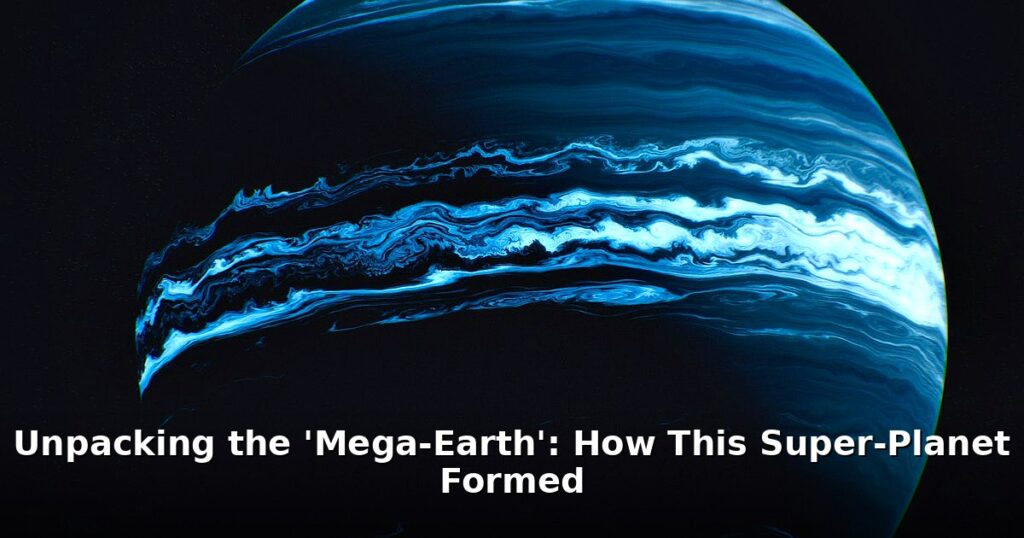

Remember that feeling when you thought you knew pretty much everything about planets? Rocky ones like Earth, gas giants like Jupiter, maybe an ice giant like Neptune if you were feeling fancy. Well, turns out the universe had a surprise up its sleeve, and it’s a big one. Literally. Scientists have identified a new class of planet, dubbed a ‘Mega-Earth,’ and its very existence is making them scratch their heads about how planets form in the first place. This isn’t just a slight tweak to our understanding; it’s a fundamental challenge to our models of mega-earth formation.
Table of Contents
what’s This ‘Mega-Earth’ Everyone’s Talking About?
Let’s introduce the star of our show, or rather, the planet of our show: Kepler-10c. This isn’t just another blip on a telescope screen. Discovered by NASA’s Kepler Space Telescope (hence the name), Kepler-10c has been nicknamed a ‘Mega-Earth’ because it’s massive, but it’s not a gas giant. That’s the key distinction. We’re talking about a planet that’s roughly 2.3 times the radius of Earth, but an astonishing 17 times Earth’s mass.
Think about that for a second. Seventeen Earths worth of material, packed into a rocky sphere. For comparison, our own solar system’s gas giants, like Jupiter, are primarily made of hydrogen and helium. While they’re far more massive than Kepler-10c, their density is much lower. Kepler-10c, on the other hand, is dense. Really dense. Its average density is higher than Earth’s, suggesting a solid, rocky composition, not a puffy ball of gas. Check out our guide on New Moon Crater: NASA Spots SpaceX Rocket Impact Site. We covered this in Viral Genes: How Ancient Viruses Shaped Mammal Evolution.
This big boy orbits a star named Kepler-10, which is about 560 light-years away in the constellation Draco. It’s part of a two-planet system, with its smaller sibling, Kepler-10b, being a ‘super-Earth’ – another class of rocky planet larger than Earth but not as extreme as 10c. Kepler-10c itself whips around its star pretty quickly, completing an orbit in about 45 days. Definitely not a vacation spot, given its proximity to its star and probable scorching temperatures.
The Head-Scratching Mystery of Mega-Earth Formation
Now, this is where it gets truly interesting. Kepler-10c isn’t just big; its very existence throws a wrench into our most widely accepted theories about how planets form. For decades, the leading model for terrestrial planet formation has been the ‘core accretion’ model.
Here’s the simplified version: in a protoplanetary disk (a swirling cloud of gas and dust around a young star), tiny dust grains stick together, gradually forming pebbles, then rocks, then planetesimals, and eventually, a solid planetary core. If this core gets massive enough, say around 5 to 10 Earth masses, its gravity becomes strong enough to rapidly pull in vast amounts of the surrounding gas, leading to the formation of a gas giant like Jupiter or Saturn. The general thinking was that once a rocky core hit a certain size threshold, it would inevitably accrete a thick gaseous envelope, preventing it from remaining purely rocky.
But then Kepler-10c comes along, a planet 17 times the mass of Earth, and it’s still rocky. No massive, puffy gas envelope. It’s like finding an Olympic weightlifter who’s pure muscle, no fat, but also twice the size of any other human. It just shouldn’t be possible according to the old rules.
Look, This challenges our understanding of the critical mass needed for gas accretion and the conditions within protoplanetary disks. How could a rocky planet grow so large without becoming a gas giant? This isn’t a small problem; it implies we’re missing a significant piece of the puzzle regarding super-earth planets and the upper limits of rocky world formation. It really makes you wonder what else is out there that defies our current understanding.
Leading Theories on How a Mega-Earth Could Form
Since the discovery of Kepler-10c, scientists have been scrambling to come up with new or revised planet formation theories that can account for such a colossal rocky world. It’s forcing a re-evaluation of everything we thought we knew.
- Slow and Steady Accretion in a Dense Disk: One idea suggests that Kepler-10c formed in a particularly dense protoplanetary disk, but one that was somehow depleted of gas relatively early in its star’s life. If there was plenty of solid material available but not enough gas to accrete into a thick atmosphere, the planet could just keep piling on rock and metal. It’s like having all the bricks you need, but no mortar to build a flimsy wall.
- Collisional Growth: Another compelling theory involves violent collisions. Maybe several large, rocky protoplanets smashed into each other over a long period. These weren’t gentle mergers; these were epic, planet-shattering impacts that slowly built up an enormous core. Think of it like a cosmic demolition derby, with the biggest survivors forming this Mega-Earth. This kind of chaotic growth could explain the sheer amount of material packed into one body.
- Migration Theories: What if Kepler-10c didn’t form where it’s now? Planetary migration is a well-accepted concept for many exoplanets. Perhaps this Mega-Earth formed further out in its planetary system, in a cooler region where icy materials were abundant alongside rock. These ice-rock mixtures could have allowed it to gather more mass before migrating inward to its current, hotter orbit, where any initial icy components would have evaporated, leaving behind a dense, rocky core.
- The Role of Heavy Elements and Stellar Metallicity: The composition of the parent star, referred to as its metallicity (the abundance of elements heavier than hydrogen and helium), in planet formation. Stars rich in these ‘metals’ tend to have more material available in their disks for planets to form from. A high metallicity in the Kepler-10 system could have provided the necessary building blocks for such a massive rocky core. It’s all about the ingredients, after all.
The truth is, we don’t have a definitive answer yet. Each theory has its strengths and weaknesses, and scientists are using sophisticated simulations to test which scenarios are most plausible. It’s the dynamic nature of scientific discovery.
What Kepler-10c Tells Us About Planet Diversity
The discovery of Kepler-10c is more than just an interesting anomaly; it profoundly expands our understanding of exoplanet discovery and the sheer diversity of worlds out there. Before, we had our familiar solar system planets, plus a growing collection of ‘hot Jupiters’ (gas giants orbiting very close to their stars) and ‘super-Earths.’ Kepler-10c gives us a whole new category. A ‘Mega-Earth’ isn’t just a bigger super-Earth; it breaks a theoretical barrier.
This means the universe isn’t just churning out slight variations of what we already know. It’s creating entirely new types of worlds, each with its own unique story of formation and evolution. This has huge implications for the search for life. While Kepler-10c itself is likely a sterile, scorching hot world due to its proximity to its star and the extreme Kepler-10c characteristics, the existence of Mega-Earths elsewhere could be a .
Imagine a Mega-Earth orbiting its star in the habitable zone – the region where liquid water could exist on its surface. Such a planet would have immense gravity, potentially holding onto a thicker atmosphere for longer, and its internal geological activity could be vastly different from Earth’s. Would this make life more likely, or less? We simply don’t know, but it opens up entirely new avenues for speculation and research.
The ongoing search for diverse exoplanets is like opening a cosmic cookbook, finding recipes we never imagined. Each new discovery refines our understanding of planetary evolution and the conditions under which life might arise. It’s a humbling reminder of how little we truly know about the cosmos. Go figure.
Looking Ahead: The Future of Mega-Earth Research
Fair warning: So, what’s next for Mega-Earths? A whole lot more looking and a whole lot more thinking, that’s what. New telescopes, like the James Webb Space Telescope, are already providing unprecedented views of exoplanet atmospheres. While Kepler-10c might be too distant and too hot for detailed atmospheric analysis right now, future instruments will be able to probe the atmospheres of other, potentially cooler, Mega-Earth candidates. This will give us clues about their composition, temperature, and even the presence of water or other biosignatures.
Look, Scientists will continue to refine our understanding of planetary system evolution, incorporating these new discoveries into their models. The goal is to build a more complete picture of how planets form, migrate, and interact within their stellar neighborhoods. The discovery of a truly massive rocky world like Kepler-10c forces us to consider a wider range of possibilities for mega-earth formation than ever before.
And yes, the search for more Mega-Earths is definitely on. Finding more of them, especially in different stellar environments, will help confirm if Kepler-10c is an outlier or if these massive rocky worlds are a more common feature of our galaxy than we previously thought. Each new data point helps us paint a clearer, more intricate picture of the universe around us. It’s an exciting time to be alive, watching these cosmic mysteries unfold.
You might not expect this, but For more detailed scientific information on Kepler-10c and its discovery, you can check out the NASA Kepler mission page. You might also find fascinating insights into exoplanet research from institutions like the NASA Exoplanet Archive.
Frequently Asked Questions
Q: what’s a ‘Mega-Earth’?
A: A Mega-Earth is a newly identified class of exoplanet that’s significantly more massive than Earth but still primarily rocky, unlike gas giants. Kepler-10c, for example, is about 17 times Earth’s mass.
Q: How does a Mega-Earth differ from a Super-Earth?
A: Super-Earths are also rocky planets larger than Earth, typically up to 10 times Earth’s mass. Mega-Earths push this boundary further, suggesting a new category for extremely massive rocky worlds, challenging previous ideas about how large rocky planets could get before becoming gas giants.
Look, Q: Why is the discovery of Kepler-10c significant?
A: Its significance lies in its immense rocky mass, which current planet formation models struggle to explain. It forces scientists to rethink how planets accumulate material and grow, particularly for large, dense bodies, expanding our understanding of planetary diversity.
Q: Could a Mega-Earth support life?
A: While Kepler-10c itself is likely too close to its star and lacks a thick atmosphere, the existence of Mega-Earths opens the possibility of other, more distant ones potentially supporting life. Their sheer size and mass could mean different atmospheric dynamics or geological activity.