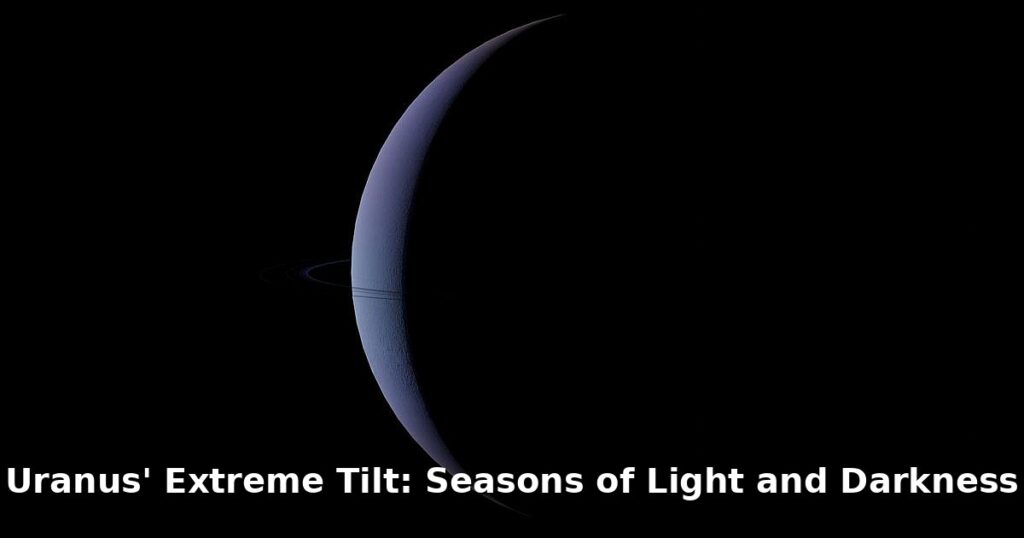

Okay, so you think you’ve got rough seasons here on Earth, right? A snowy winter, a sweltering summer. Maybe a week or two of heatwave, or a particularly brutal cold snap. Cute. Now imagine a season that lasts for 42 years. Forty-two Earth years. And not just any season, but 42 years of continuous, unbroken daylight, followed by 42 years of pitch-black, frigid darkness. That’s the reality on Uranus, and it’s all thanks to Uranus’ extreme tilt.
Table of Contents
Most planets in our solar system spin more or less upright as they orbit the Sun. Earth’s tilt is a comfortable 23.5 degrees, giving us our familiar four seasons. Mars is similar, at around 25 degrees. But Uranus? That icy giant decided to go rogue. Its axial tilt is a mind-boggling 98 degrees. Think about that for a second. It’s not just leaning a little; it’s practically lying on its side, rolling around the Sun like a cosmic bowling ball. This isn’t just a quirky detail; it fundamentally changes everything about the planet’s environment.
Uranus’ Extreme Tilt: A Cosmic Anomaly
When you picture a planet orbiting the Sun, you usually imagine it spinning like a top, with its poles pointing generally north and south relative to its orbital plane. Not Uranus. Its unique orientation means that instead of spinning, it essentially rolls. One pole leads the way for a quarter of its nearly 84-year orbit, then its equator faces the Sun, then the other pole, and so on. It’s quite a dance. Pretty wild, right? Check out our guide on Unveiling GJ 887 d: Our Second Closest Habitable Planet Neighbor. We covered this in Wildfire Evacuates NASA’s Deep Space Network Complex in Spain.
This nearly 98-degree axial tilt is the star of the show here. It’s the reason for the wild climate swings. No other planet in our solar system has anything close to this kind of tilt. It’s truly a one-of-a-kind astronomical phenomenon, and it creates some seriously harsh conditions that are hard for us Earthlings to even wrap our heads around.
And these extreme conditions dictate the seasons. Forget spring, summer, autumn, and winter in neat three-month packages. On Uranus, you get two main acts for each pole: decades of light, then decades of dark. Big difference.
The Pole’s Endless Summer: 42 Years of Sunlight
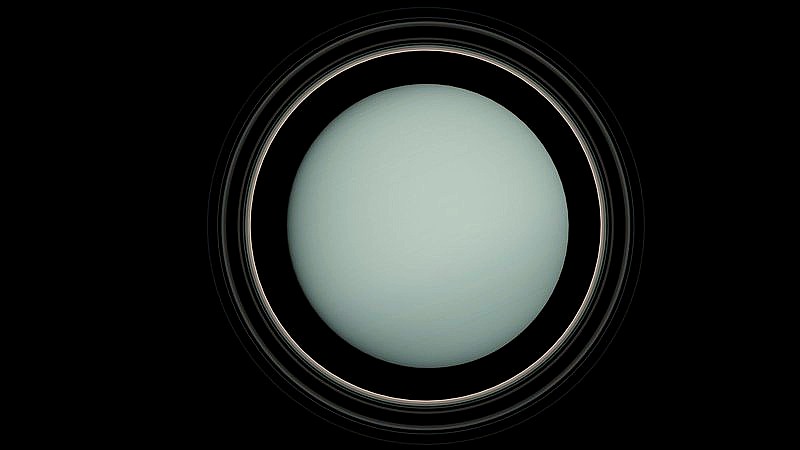
Let’s start with the “summer.” Imagine standing at one of Uranus’ poles when it’s pointed directly at the Sun. For roughly 42 Earth years, that spot would be bathed in continuous daylight. The Sun would barely move from the sky, a perpetual twilight, never setting. That’s an entire human lifetime, for some, spent under an unblinking gaze.
You might think, “Oh, continuous sunlight, that sounds cozy!” But this is Uranus, an ice giant. While the Sun’s energy is constant, it’s still incredibly far away. So, “warm” is a relative term. Temperatures during this prolonged illumination can still be brutally cold, but the sustained solar radiation does have an effect. It drives powerful atmospheric currents and can cause interesting photochemical reactions in the planet’s upper atmosphere, altering its composition.
Fair warning: The lack of a day-night cycle for decades fundamentally changes how energy is distributed. On Earth, the daily rotation helps to even out temperatures, with heat building up during the day and dissipating at night. On Uranus, with one pole constantly baking (relatively speaking) and the other constantly freezing, you get massive temperature gradients. This fuels some truly epic weather systems, creating an incredibly dynamic, if frigid, environment.
Brutal Darkness: 42 Years of Unbroken Night
And then, the other shoe drops. Or rather, the other pole emerges. As Uranus continues its long orbit, the pole that was enjoying its decades-long “summer” gradually begins to point away from the Sun. Eventually, it plunges into approximately 42 years of unbroken darkness. Forty-two years. No sunrise, no sunset, just an endless night.
During this prolonged night, the temperatures plummet even further. Without any solar input, the atmosphere at the pole cools dramatically. This extreme temperature drop causes gases in the atmosphere, like methane, to condense and freeze, potentially forming clouds or even falling as icy precipitation. It’s a deep freeze that’s hard to fathom.
This cycle of extreme light and extreme dark plays a huge role in Uranus’ weather patterns. The transition from light to dark, or vice versa, means dramatic shifts in energy input. This can generate powerful storms and winds as the atmosphere tries to redistribute heat and equalize pressure. It’s not a gentle transition, either; it’s a slow, agonizing slide into or out of decades of extreme conditions. The planet’s unique orbit and Uranus’ axial tilt are truly the driving forces behind this meteorological madness.
Comparing Uranus’ Rotation to Other Planets
To really appreciate just how weird Uranus’ rotation is, let’s stack it up against some of its neighbors. Earth, as I mentioned, has an axial tilt of about 23.5 degrees. This is pretty much ideal for varied seasons and stable climates, allowing for liquid water and, well, us. Mars is similar at 25 degrees, and it also experiences seasons, though they’re more extreme due to its thinner atmosphere and elliptical orbit.
Jupiter, the grandaddy of them all, has a tiny axial tilt of just over 3 degrees. This means Jupiter barely has any seasons at all. Its massive storms and atmospheric dynamics are driven by internal heat and rapid rotation, not solar insolation differences.
So, when you consider Uranus’ nearly 98-degree tilt, it truly stands alone. It’s not just a little off-kilter; it’s practically horizontal. This unique orientation has puzzled scientists for a long time. The prevailing theory, which seems pretty solid, is that Uranus’ extreme tilt was caused by one or more massive collisions with Earth-sized protoplanets very early in the solar system’s history. Imagine an impact so violent it knocked an entire planet onto its side! That’s some serious cosmic billiards.
And because of this, the seasons on Uranus are unlike anything else we know. The planet’s unique orbit makes it a fascinating, if inhospitable, world.
Life (or Lack Thereof) Under Extreme Conditions
Okay, so Now, the big question: could anything live there? With 42 years of endless day and 42 years of unbroken night, any potential life forms would face immense challenges. On Earth, life adapts to daily and seasonal cycles. We have circadian rhythms, hibernation, migration, and all sorts of strategies to cope with relatively short-term environmental changes. But decades-long environmental stability (or lack thereof)? That’s a whole different ballgame.
Consider the energy requirements. How would an organism survive 42 years of no light for photosynthesis, or 42 years of constant radiation exposure? It would need incredible metabolic flexibility, or perhaps a way to burrow deep into the planet’s interior to escape the surface extremes. The extreme temperature swings alone would be lethal to most known forms of life. On the flip side, the constant freezing and thawing, or the perpetual freeze, just doesn’t sound very life-friendly.
These conditions also have a profound impact on Uranus’ atmospheric chemistry. The long periods of sunlight can drive photochemical reactions, creating complex hydrocarbons in the upper atmosphere. During the dark periods, these compounds might condense or react differently. Scientists study these processes to understand how planets evolve, and Uranus’ unique rotation provides a natural laboratory for extreme chemistry. NASA and other space agencies continue to observe Uranus, hoping to send new missions to unlock more of its secrets.
Understanding Uranus’ axial tilt and the resulting extreme climate helps us appreciate the incredible diversity of planets in our solar system and beyond. It’s a stark reminder that our comfortable blue planet, with its balanced seasons and regular day-night cycles, is truly a special place. And when I think about fixing a leaky faucet or painting a room, it suddenly seems a lot less daunting than surviving a Uranian winter. Just saying.
Frequently Asked Questions
Q: what’s Uranus’ axial tilt?
A: Uranus has an axial tilt of approximately 98 degrees. This means it essentially orbits the Sun lying on its side, a unique orientation compared to other planets in our solar system.
Q: How long are seasons on Uranus?
A: Due to its extreme tilt, each pole of Uranus experiences seasons lasting about 42 Earth years. This includes 42 years of continuous sunlight followed by 42 years of unbroken darkness.
Q: Why is Uranus tilted so much?
A: Scientists believe Uranus’ extreme tilt was likely caused by one or more massive collisions with Earth-sized protoplanets early in the solar system’s history. These impacts could have knocked the planet onto its side. For more information, you can check out NASA’s Solar System Exploration site.
Q: Does Uranus have a day and night cycle like Earth?
A: Uranus does have a rotational period of about 17 hours, but due to its extreme tilt, the concept of a regular day-night cycle is drastically altered. For decades, a pole can experience continuous light or continuous darkness, making its ‘days’ and ‘nights’ incredibly long and unique.