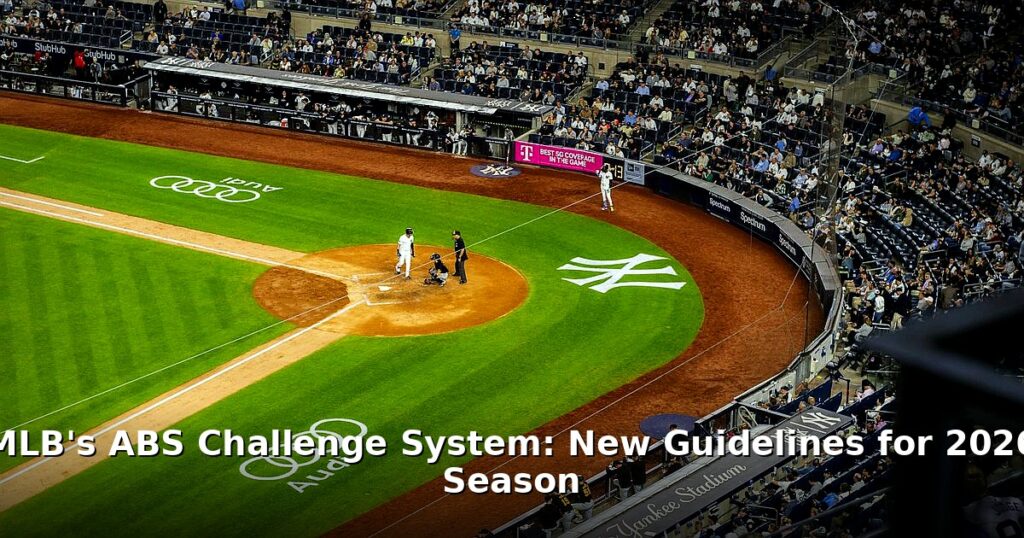

Get ready for a seismic shift in Major League Baseball! Forget everything you thought you knew about arguing balls and strikes, because the future is officially here. MLB just dropped a bombshell: the ABS challenge system is coming to the big leagues in 2026. That’s right, robot umpires are about to have a say, and baseball will never be the same.
MLB Officially Adopts ABS Challenge System for 2026 Season
The announcement, made early this week, confirms what many have suspected for years: the days of relying solely on the human eye behind the plate are numbered. The ABS challenge system, or Automated Balls and Strikes challenge system, uses advanced technology, including high-speed cameras and sophisticated algorithms, to determine whether a pitch is a ball or a strike. It’s been brewing in the minor leagues, and now it’s ready for the bright lights of MLB.
Fair warning: This isn’t just some minor rule tweak. This is a fundamental change in how the game is played and officiated. For years, we’ve seen blown calls behind the plate swing games, ignite controversies, and leave fans screaming at their TVs. The move from testing to full implementation signifies a major step towards increased accuracy and fairness. It’s a bold decision, and one that’s sure to spark debate among players, managers, and fans alike. You might also enjoy: Beaudry & Cizeron’s Olympic Ice Dance Win: Was It Controversial?. You might also enjoy: Justin Verlander Signs With Tigers: A Detroit Homecoming!.
And frankly, I’m stoked! Think of all the arguments it will save! No more getting tossed for disagreeing with a bad call. Instead, managers get to strategically deploy their challenges. The chess match just got a whole lot more interesting.
Decoding the ABS Challenge System: How It Works
So, how will this all work in practice? Let’s break down the mechanics of the ABS challenge system.
The Challenge Process
The challenge process is relatively straightforward. Each team will be granted a limited number of challenges per game, likely one to three. The exact number is still being finalized, but the principle remains the same: use them wisely. When a manager (or, in some cases, a designated player) believes the home plate umpire has made an incorrect call on a ball or strike, they can initiate a challenge. They’ll signal to the umpire, who will then trigger the automated review process. The automated system instantaneously assesses the pitch and relays the correct call. The whole thing should take just a few seconds.
Successful vs. Failed Challenges
The stakes are high! If the challenge is successful and the call is overturned, the team retains their challenge. Then again, if the challenge fails and the original call stands, the team loses a challenge. This adds a significant strategic element to the game. Do you burn a challenge early on a borderline call, or save it for a crucial moment in a late-inning situation? The decision-making will be fascinating to watch.
Challenge Limitations
Not every call is challengeable. MLB is implementing specific guidelines to prevent the system from being abused or slowing the game down excessively. For instance, challenges will likely be restricted to balls and strikes only. Other calls, such as those on fair/foul balls, tag plays, or check swings, will remain solely at the discretion of the human umpires. The check swing is an interesting one, though. I wonder if they’ll eventually add cameras for that call, too. One step at a time, I guess.
The Shifting Role of Umpires and the Impact on the Game
The introduction of the ABS challenge system begs the question: are umpires becoming obsolete? The answer is a resounding no. While their role in calling balls and strikes will be diminished, their expertise and judgment will still be crucial. They’ll continue to oversee all other aspects of the game, including fair/foul calls, safe/out calls, and maintaining order on the field. Think of it as a specialization of duties.
One big question is whether this will speed up or slow down the game. On the one hand, fewer arguments could shorten games. On the other hand, the challenge process itself could add time. I suspect that MLB will be closely monitoring game times and will make adjustments to the system as needed.
Here’s what most people miss: The biggest benefit, of course, is the potential for increased fairness and accuracy. The automated balls and strikes system is designed to eliminate human error and provide consistent strike zone calls. This should lead to fewer controversial calls and a more level playing field for all teams. MLB is also investing in enhanced training programs for umpires to help them adapt to their evolving roles and to ensure they remain proficient in all other aspects of the game.
Player and Manager Reactions: A Mixed Bag
Real talk: Unsurprisingly, the announcement of the ABS challenge system has been met with a range of reactions from players and managers. Some are cautiously optimistic, while others express concerns about the impact on the game’s traditions and the human element of umpiring.
Early reports suggest that some managers are already strategizing about how to best their challenges. Some might adopt an aggressive approach, challenging borderline calls early in the game to gain an advantage. Others might prefer a more conservative strategy, saving their challenges for high- situations. It’s going to be fascinating to see how these strategies evolve over time.
Of course, there are concerns. Some players worry that the system will be too rigid and that it won’t account for the nuances of pitching and hitting. Others fear that it will slow the game down or that it will undermine the authority of the umpires. MLB is aware of these concerns and is committed to addressing them through ongoing dialogue with players and managers.
I can already see the memes if a robot umpire blows a call…wait, can a robot blow a call? That’s a philosophical question for another day.
The Horizon: The Future of MLB Umpiring
The introduction of the ABS challenge system is just the beginning. Looking ahead, we can expect to see further technological advancements in umpiring and a continued evolution of the game. One possibility is the eventual implementation of a fully automated balls and strikes system, where all calls are made electronically, eliminating the need for human intervention altogether. But that’s likely a decade or more away. For now, the challenge system represents a significant step in that direction.
The baseball rules are evolving, and this is a clear example. The ABS challenge system itself could also evolve beyond 2026. MLB might adjust the number of challenges per game, the types of calls that can be challenged, or the way the system is implemented. The key will be finding the right balance between accuracy, efficiency, and the preservation of the game’s traditions.
This is more than just about balls and strikes. It’s about the very soul of the game. Can technology enhance the sport we love without stripping away its humanity? Only time will tell, but I, for one, am excited to see what the future holds.
Frequently Asked Questions
what’s the ABS challenge system in MLB?
The ABS challenge system allows managers and players to challenge ball and strike calls made by the home plate umpire. An automated system then reviews the call, and the challenge is either upheld or overturned. This system is intended to increase the accuracy of calls.
When will the ABS challenge system be implemented in MLB?
MLB plans to fully implement the ABS challenge system for all teams starting in the 2026 season. Prior to that, it will likely be tested in select minor league games.
Will umpires be replaced by robots?
I’ll be honest — No, human umpires will still be an essential part of baseball games. Their roles will evolve to include other responsibilities, but they will still be present on the field. They will still make calls on plays other than balls and strikes.
What do you think? Are you excited about the ABS challenge system? Nervous? Let me know in the comments!