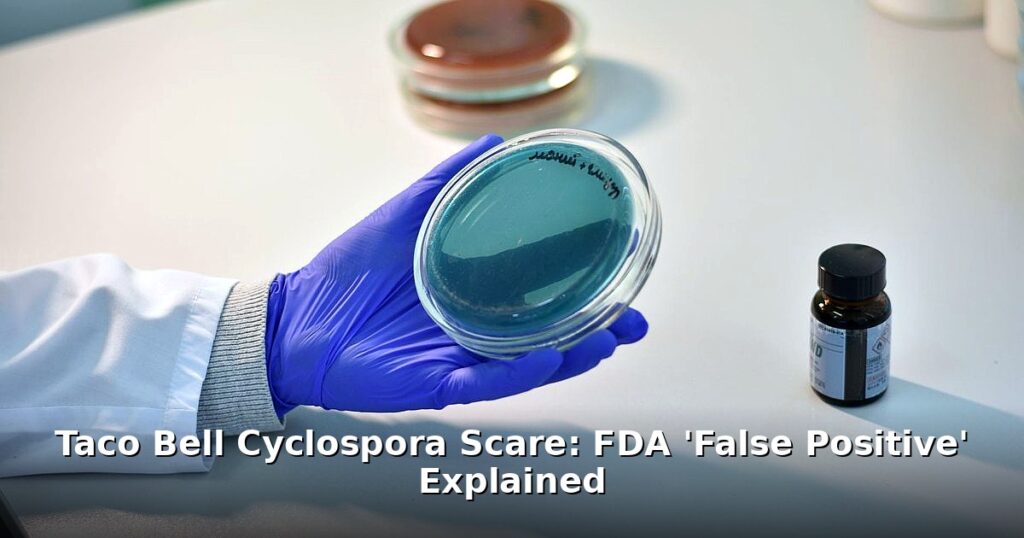

Remember that unsettling feeling a while back, when headlines screamed about a potential Cyclospora outbreak linked to a major fast-food chain? Specifically, Taco Bell. It was one of those moments that sends a shiver down your spine, making you second-guess your next drive-thru order. The initial reports, disseminated by the FDA, suggested that Cyclospora had been detected in lettuce from a supplier serving Taco Bell. Big news. Scary news. But here’s the thing about investigations, especially in the complex world of food safety: sometimes the first answer isn’t the final one. And in this case, the early alarm about Taco Bell Cyclospora false positive results turned out to be just that – an alarm that didn’t need to be rung.
Table of Contents
It’s a situation that brings up so many questions about how we perceive food safety, the inherent challenges in large-scale testing, and what it truly means for our confidence in the food supply. Let’s unpack it.
The Initial Scare: Cyclospora Found in Taco Bell Supplier’s Lettuce
Back in July 2020, the U.S. Food and Drug Administration (FDA) issued an announcement that certainly grabbed everyone’s attention. They stated that Fresh Express, a prominent produce supplier, had initiated a voluntary recall of various salad products. The reason? A potential contamination with Cyclospora cayetanensis, a nasty microscopic parasite. This wasn’t just any recall; the FDA’s investigation into an ongoing multi-state cyclosporiasis outbreak had pointed to Fresh Express as a common link. And, crucially for many consumers, Fresh Express was also a supplier of iceberg lettuce for Taco Bell. No joke. Check out our guide on Taylor Farms Cyclospora Recall: What Consumers Need to Know. We covered this in Taylor Farms Iceberg Lettuce Recall: What Consumers Need to Know.
The news spread like wildfire. Taco Bell, a ubiquitous presence in the fast-food landscape, immediately found itself in the spotlight. While the company quickly announced it had stopped using the implicated lettuce from that specific Fresh Express facility and switched to other sources, the damage to public perception was done. People were concerned about Cyclospora food safety, understandably so. A foodborne illness outbreak, even a suspected one, can quickly erode trust, prompting questions about everything from farming practices to restaurant hygiene.
Think about it: you’re just trying to enjoy a Crunchwrap Supreme, and suddenly you’re contemplating parasites. Not great. The public reaction was swift, a mix of concern, calls for transparency, and for some, an immediate boycott. The potential scope of contamination felt huge, touching not just grocery store shelves but also popular dining spots.
Unpacking the ‘False Positive’: What Does it Mean for Taco Bell Cyclospora?
Okay, so This is where the story takes a critical turn, and frankly, it’s a crucial lesson in how science and public health investigations actually work. A ‘false positive’ in scientific testing means that a test result incorrectly indicates the presence of a condition or substance when it’s, in fact, absent. In simpler terms, the test said “yes, it’s here,” but it was wrong. It’s like your smoke detector going off because you burned toast, not because your house is actually on fire.
For the FDA’s testing accuracy, identifying that initial finding as incorrect involved a rigorous process of re-testing and verification. The agency continued its investigation, employing advanced molecular methods and epidemiological traceback. They scrutinize every step: from sample collection, laboratory analysis, to data interpretation. What they found, after extensive follow-up, was that the initial detection of Cyclospora in the Fresh Express lettuce samples did not hold up to further, more precise scrutiny. The parasite wasn’t actually present in a viable form, or perhaps the initial detection was a transient, non-replicating fragment, or even a lab error. The specifics here are complex, but the outcome was clear: no actual contamination.
This whole situation highlights the incredible intricacies of foodborne illness testing. Pathogen detection methods are constantly evolving, becoming more sensitive. That increased sensitivity is a double-edged sword; it helps catch real threats early, but it also increases the chance of picking up non-threatening signals that can lead to false positives. The FDA, like other regulatory bodies, uses a battery of methods, including PCR (polymerase chain reaction) tests, which detect genetic material, and microscopic examination. Each has its strengths and limitations. Confirming a true positive often requires multiple tests and cultures to ensure the detected pathogen is viable and present at levels that could cause illness.
The Realities of Food Safety Testing: Accuracy and Challenges
I’ll be honest — When you’re dealing with a global food supply chain, testing for every conceivable pathogen in every single batch of produce is an astronomical undertaking. It’s not just about one lab test; it’s about managing immense volumes of food, diverse growing conditions, and countless points where contamination could theoretically occur. The inherent challenges in large-scale foodborne parasite outbreaks prevention and testing are immense. You’ve got risks like cross-contamination in the field, during harvesting, transport, or even within the testing laboratories themselves. And then there’s the variable nature of pathogens—some are hardy, some are fragile; some are easily detectable, others hide well.
But this is where supply chain management truly shines, even when testing anomalies pop up. Companies like Taco Bell and their suppliers have intricate systems in place. They don’t just rely on a single test. They have traceability programs that can pinpoint exactly where a batch of lettuce came from, when it was harvested, and where it was distributed. This allows for rapid isolation of suspect products and swift switching to alternative, verified sources, as Taco Bell did. These aren’t just good practices; they’re essential for mitigating risks and protecting public health, regardless of initial test results.
The role of continuous monitoring and re-testing can’t be overstated. An initial positive finding isn’t the end of the story; it’s the beginning of a deeper investigation. Regulatory bodies and food companies conduct confirmatory tests, often using different methods or laboratories, to either confirm or refute those initial findings. It’s this painstaking, often behind-the-scenes, work that ensures public statements are accurate and that consumers aren’t unnecessarily alarmed or, worse, exposed to actual danger. So yeah, it’s a painstaking process, but absolutely vital for produce supplier recalls and proactive safety.
Lessons Learned: Industry Response and Consumer Trust
So, what do we take away from this whole Taco Bell Cyclospora false positive incident? For food companies and regulatory bodies, it underscores the intense pressure and the delicate balance they must maintain. When a potential food safety threat emerges, the default response is often to act quickly and cautiously, prioritizing public health. This means issuing alerts and initiating recalls based on initial, sometimes unconfirmed, data. It’s a hard line to walk: act too slow, and people get sick; act too fast, and you might cause unnecessary panic and economic disruption.
transparent communication during such incidents is paramount. While initial reports can be alarming, how a company or agency communicates updates, corrections, and the eventual resolution speaks volumes. Taco Bell was transparent about switching suppliers, and the FDA was transparent about their ongoing investigation and eventual retraction of the initial finding. This openness, even when admitting a mistake (the false positive), is crucial for maintaining whatever consumer trust remains.
And that brings me to a bit of a “wish I knew this sooner” moment: how quickly public trust can erode, and how much effort it takes to rebuild, even when the initial threat isn’t real. When those headlines about potential contamination break, the damage is almost instantaneous. People hear “Taco Bell” and “parasite” in the same sentence, and that image sticks, sometimes for years. Even when the all-clear is given, the lingering doubt can be incredibly hard to shake. It takes consistent, proactive measures, transparent communication, and a long track record of safety to truly restore consumer confidence. It’s not just about cleaning up the mess; it’s about diligently preventing future ones and clearly communicating those efforts.
This incident ultimately served as a real-world stress test for the food safety system, demonstrating both its vulnerabilities and its strengths. The system caught a potential issue, investigated it thoroughly, and corrected the record. That’s how it’s supposed to work, even if the initial scare felt, well, scary.
Frequently Asked Questions
what’s Cyclospora?
Cyclospora cayetanensis is a microscopic parasite that can cause an intestinal infection called cyclosporiasis. People can become infected by consuming food or water contaminated with the parasite. Symptoms often include watery diarrhea, loss of appetite, weight loss, abdominal cramps, bloating, nausea, and fatigue. It’s not a fun time, which is why foodborne parasite outbreaks are taken so seriously. Not ideal.
How common are false positives in food safety testing?
While not extremely common for established pathogens, false positives can occur due to various factors like cross-contamination in labs, highly sensitive tests picking up inactive traces, or non-specific reactions. Rigorous re-testing protocols are crucial to confirm initial findings. It’s part of the inherent challenge in achieving perfect FDA testing accuracy with such tiny organisms.
Was anyone sickened by the Taco Bell Cyclospora scare?
No, the FDA’s subsequent investigation determined the initial findings to be a ‘false positive,’ meaning there was no confirmed Cyclospora contamination and no associated illnesses linked to this specific incident at Taco Bell or its supplier. This is the key takeaway from the whole Taco Bell Cyclospora false positive saga.
What steps do food companies take to ensure produce safety?
Food companies implement stringent safety protocols, including sourcing from approved suppliers, regular testing, adherence to Good Agricultural Practices (GAPs) and Good Manufacturing Practices (GMPs), and traceability systems to quickly identify and isolate any contaminated products. This comprehensive approach is vital for preventing and responding to potential issues, ensuring overall food safety across the supply chain.