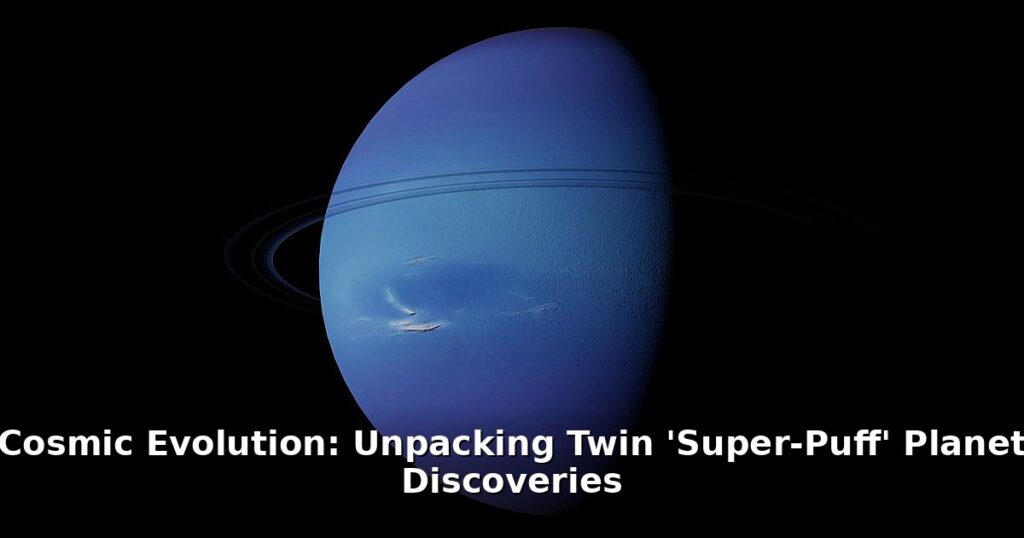

Alright, so imagine you’re trying to figure out how planets form, right? You’ve got your neat little models: rocky planets close to the star, gas giants further out. It all makes sense. Then, BAM! The universe throws a curveball, and suddenly you’re looking at something that just doesn’t fit the mold. That’s pretty much what happened with the discovery of super-puff planets, and let me tell you, these things are wild.
Table of Contents
I’ve tackled some bizarre home renovation projects in my time – like that one time I tried to turn a shed into a sauna. (Spoiler: it got a little too steamy, and not in a good way.) But even that doesn’t compare to the head-scratching mystery these celestial oddities present. They’re changing the game for how we think about cosmic evolution.
What Are ‘Super-Puff’ Planets Anyway?
So, what exactly are we talking about when we say ‘super-puff’? Think of them as the cosmic equivalent of cotton candy, but on a truly massive scale. These exoplanets are defined by their remarkably low density for their size. Picture a planet that’s bigger than Earth, sometimes even approaching the size of Neptune, but with only a fraction of the mass. It’s like having a giant beach ball that looks solid but is mostly air. Check out our guide on Magnetar Flare: The 2004 Galactic Burst That Hit Earth. We covered this in Starfall: SpaceX’s Vision for Orbital Cargo Delivery.
They truly defy easy categorization. Most planets fall into neat little boxes: rocky terrestrial planets (like Mars or Earth) or gas giants (like Jupiter or Saturn). But super-puffs? They’re larger than Earth, no doubt about that. Yet, they’re significantly lighter than our ice giants, Neptune or Uranus. It’s a real conundrum.
The ‘cotton candy’ analogy isn’t just a cute way to describe them; it really helps visualize their ethereal nature. If you could somehow hold one (and survive the unimaginable heat and radiation), it would feel incredibly light for its enormous volume. They have incredibly extended atmospheres, far more spread out than what we see in our solar system.
Their discovery history is relatively brief, making them a more recent and intriguing addition to the exoplanet family. They’re not a common type of exoplanet, which makes each new finding, especially a twin system, all the more exciting for scientists trying to piece together the puzzle of planetary formation theories. No joke.
The Twin Super-Puff Planets: A Unique Pairing
Now, let’s talk about the recent star of the show: the twin super-puff planets. This particular exoplanet discovery was made in a system known as Kepler-51, located hundreds of light-years away. Scientists used data from the venerable Kepler Space Telescope, which, even after its operational lifetime, continues to yield incredible insights.
The really unique part here isn’t just finding one super-puff, but finding two of them orbiting the same star. A ‘twin’ system like this is particularly significant for scientists because it offers a kind of natural experiment. When you have two planets with similar characteristics in the same stellar environment, it helps you isolate variables. Are their unusual properties due to the unique conditions of that particular star system, or is there a more universal process at play? Worth it.
Initial observations and data revealed some fascinating characteristics. Both planets, Kepler-51 b and Kepler-51 d, were found to be roughly the size of Jupiter, but with masses less than one-tenth that of Jupiter. Their densities are astonishingly low – comparable to that of cotton candy, as we discussed. Their orbital characteristics also provided clues, though not immediately obvious ones, about their formation and evolution.
The primary method used for their detection was the transit method. This involves observing a slight dip in the star’s brightness as a planet passes in front of it. By carefully measuring this dip, scientists can determine the planet’s size. To figure out the mass, and thus the density, they often combine transit data with radial velocity measurements – looking for tiny wobbles in the star caused by the planet’s gravitational pull. This combination of size and mass is what flags them as these bizarre, low-density exoplanets.
How Super-Puff Planets Challenge Planetary Formation Theories
This is where things get really interesting for planetary formation theories. Our standard models for how planets form are pretty well-established for our solar system. For gas giants like Jupiter, we have the ‘core accretion’ model: a solid core forms first, then rapidly accretes a massive gaseous envelope. For terrestrial planets, it’s about dust and pebbles sticking together over time. And there’s also the ‘disk instability’ model, where parts of the protoplanetary disk collapse under their own gravity to form gas giants quickly. No joke.
But these low-density exoplanets just don’t fit neatly into existing frameworks. Imagine trying to force a square peg into a round hole – it’s just not working. If they formed via core accretion, their cores would have to be incredibly small, and their atmospheres would have to be ridiculously expanded. If they formed via disk instability, why are they so incredibly light for their size?
The truth is, Scientists have put forth several hypotheses for their unusual structure. One idea involves stellar radiation. If these planets formed closer to their star and then migrated outwards, or if their star was particularly active early on, intense radiation could have stripped away some of their denser atmospheric layers, leaving behind a puffy, lower-mass structure. Another thought is that they have unusual atmospheric compositions – perhaps a lot of hydrogen and helium, which are very light, but somehow prevented from collapsing.
And then there’s the more dramatic possibility: past collisions. Could a massive impact have significantly expanded their atmospheres or somehow altered their internal structure? It’s all speculation right now, but it shows how these objects push the boundaries of what we thought was possible for planet construction.
Clues to Cosmic Evolution from These Alien Worlds
Fair warning: Ultimately, studying these super-puff planets isn’t just about satisfying scientific curiosity; it’s about gaining cosmic evolution clues. They offer crucial insights into the conditions for planet formation in different star systems. Our solar system isn’t necessarily the norm, and these planets show us just how diverse the planetary building blocks can be across the galaxy.
They also provide insights into stellar evolution and its impact on nascent planets. The life cycle of a star, its temperature, its activity – all of these factors play a huge role in how planets form around it and how they evolve over billions of years. These fluffy worlds might be telling us something specific about the environment around young, active stars, or stars with particular metallicities.
What we’re seeing is the potential for incredibly diverse planetary architectures across the galaxy. It’s not just rocky and gas giant. We have ice giants, mini-Neptunes, super-Earths, hot Jupiters, and now these low-density exoplanets. Each new category expands our understanding of the universe’s creativity making planets.
And what about the implications for the search for life beyond Earth? While a super-puff planet itself is highly unlikely to host life as we know it (no solid surface, extreme temperatures, etc.), understanding these extreme cases helps in expanding the habitable zone concept. It tells us more about the limits of planetary resilience and the range of conditions under which planets can exist. This knowledge helps us refine our search parameters for potentially habitable worlds, even if these particular planets aren’t it. You can learn more about exoplanets and the search for life at NASA’s Exoplanet Archive.
The Future of Studying Super-Puff Planets and Beyond
The exciting news is that we’re only just beginning to scratch the surface. Upcoming telescopes and missions are going to provide a wealth of new data. The James Webb Space Telescope (JWST), for example, is already revolutionizing exoplanet science. Its incredible infrared capabilities mean we’ll be able to perform spectroscopy and atmospheric analysis on these super-puff planets like never before. We hope to learn about their exact chemical composition, temperature profiles, and how their atmospheres are structured.
Other missions, like the Nancy Grace Roman Space Telescope, will also contribute by discovering new exoplanets and characterizing known ones. These instruments are vital for the ongoing refinement of planetary evolution models. Every new discovery, especially something as peculiar as a twin super-puff system, forces scientists to go back to the drawing board and tweak their theories. It’s how science progresses. Just something to think about.
The exciting prospect, of course, is discovering even stranger worlds. If the universe has given us cotton candy planets, what else is out there? What other types of low-density exoplanets are waiting to be found? The more we look, the more we realize how little we truly understand about the vastness and diversity of the cosmos. And that, to me, is one of the most thrilling parts of being alive right now.
Look, We’re literally watching our understanding of the universe expand, one super-puff at a time. It’s a good reminder that just when you think you’ve figured everything out – like how to perfectly hang drywall – the universe (or your house) throws a curveball. Always keep learning, always keep exploring, whether it’s the farthest reaches of space or the dusty corners of your own basement.
Frequently Asked Questions
Q: What makes a planet a ‘super-puff’?
A: A super-puff planet is characterized by an exceptionally low density for its size. It’s typically larger than Earth but has significantly less mass than gas giants like Neptune, giving it a very ‘fluffy’ or ‘airy’ structure.
Q: How are super-puff planets discovered?
A: they’re primarily discovered using the transit method, where scientists observe a dip in a star’s brightness as a planet passes in front of it. By combining this with radial velocity measurements, researchers can determine the planet’s size and mass, revealing its low density. Worth it.
Q: Why are twin super-puff planets important?
A: The discovery of twin super-puff planets within the same system is rare and offers a unique opportunity to study planetary formation under similar conditions. It helps scientists understand if their unusual characteristics are due to their environment or unique formation processes. Go figure.
Q: Do super-puff planets have solid surfaces?
A: It’s highly unlikely. Given their extremely low density, super-puff planets are thought to have large, diffuse atmospheres with no distinct solid surface, similar to gas giants but even more expanded. For more detailed scientific papers on these discoveries, you can often find them on arXiv.org, a repository for preprints of scientific papers.