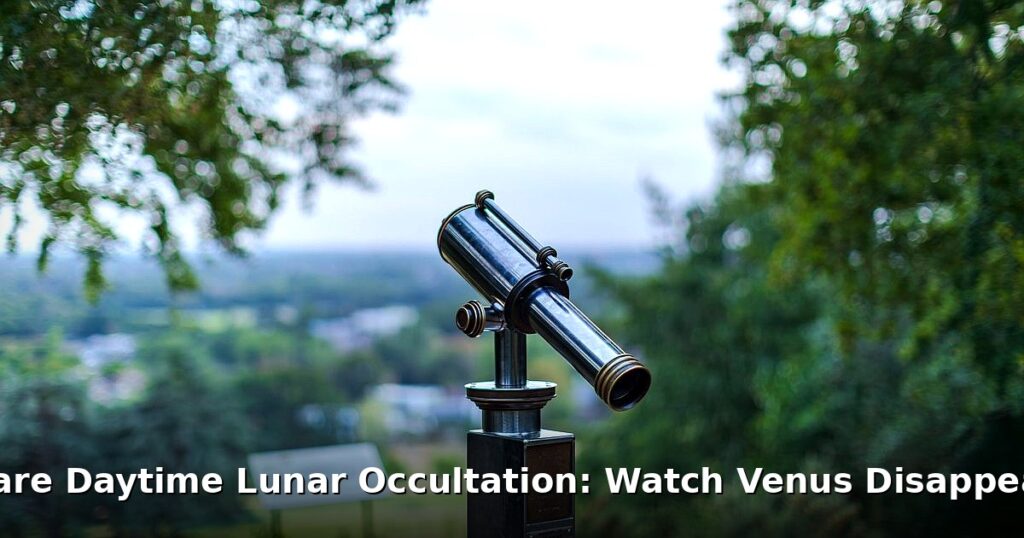

Okay, so picture this: you’re just going about your day, maybe fixing a leaky faucet or trying to figure out why the garage door opener suddenly stopped working (been there, done that, got the t-shirt). And then, out of nowhere, you hear about Venus getting swallowed by the moon. During the day! Sounds like something straight out of a sci-fi movie, right? But that’s exactly what happened during a truly spectacular and rare daytime lunar occultation not too long ago. It was one of those celestial events that just makes you stop, stare, and remember how incredibly cool our universe is.
Table of Contents
I mean, we’ve all seen the moon. And most of us have spotted Venus, that super bright “evening star” or “morning star.” But to see them dance together in broad daylight, with the moon actually passing right in front of Venus, making it disappear for a while? That’s a whole different ballgame. It wasn’t just a faint smudge; it was a visible, precise alignment that felt almost impossible to witness.
The sheer ‘wow’ factor of it was immense. It’s not every day you get to see a planetary alignment play out in real-time, especially when the sun’s still high in the sky. For a moment, it made you forget about all the DIY projects piling up and just appreciate the cosmic ballet happening above our heads. A truly humbling experience, if you ask me. Check out our guide on Satellite Internet Rescue Mission: Will It Save Your Connection?. We covered this in NASA Chooses Eric Schmidt’s Rocket Company for Mars Mission.
What Exactly is a Lunar Occultation?
Let’s clear up some common confusion first. People often mix up occultations and eclipses, and honestly, it’s an easy mistake to make. An eclipse is generally when one celestial body passes into the shadow of another. Think a lunar eclipse, where the Earth’s shadow falls on the moon, or a solar eclipse, where the moon blocks the sun’s light.
A lunar occultation, on the other hand, is when the moon passes directly in front of a more distant object, completely blocking it from our view. The moon ‘occults’ it, which is just a fancy word for ‘hides.’ It’s like a cosmic peek-a-boo, with our moon playing the starring role.
Because the moon is so much closer to us than any other planet or star, and because it’s constantly orbiting, it regularly passes in front of things. Sometimes it’s a distant star, other times it’s a planet. But the visibility of a Venus occultation, particularly one during the day, is what makes this recent event so special. Most occultations happen when the sky is dark, making the blocked object easier to spot against the blackness. But a daytime lunar occultation? That’s a different beast entirely.
Here’s the thing — The daytime aspect adds a layer of difficulty and rarity. You need the moon to be visible, of course, but also the object it’s covering, and for the sun not to totally wash everything out. It’s a tricky balance of celestial mechanics and good timing for observers on Earth.
The Science Behind the Sky Show: Venus and Our Moon
So, let’s talk about the stars (and planets) of the show. Venus, often called Earth’s “sister planet,” is a fascinating world. It’s roughly the same size as Earth, but that’s where the similarities end. It’s got a super dense, toxic atmosphere, and it’s incredibly hot. Not exactly a vacation spot. But from our perspective here on Earth, it’s often the brightest object in the night sky after the moon, and sometimes even visible during the day if you know where to look.
Our moon, of course, is our constant companion. It’s a relatively large moon for a planet our size, and its movement across our sky is what creates these visual ‘cover-ups’. Its orbit isn’t perfectly aligned with the ecliptic (the plane where most of the planets orbit), which is why we don’t have an occultation or an eclipse every single month. These specific celestial events explained by the precise tilt and timing of the moon’s path.
Okay, so When the moon and Venus alignment is just right, and they both happen to be in a position relative to the Sun and Earth that allows for daytime visibility, that’s when you get this kind of spectacle. It’s the predictable, yet sometimes awe-inspiring, clockwork of our solar system. A tiny shift in any of those orbits, and the show just wouldn’t happen.
Caught on Camera: Watching the Timelapse
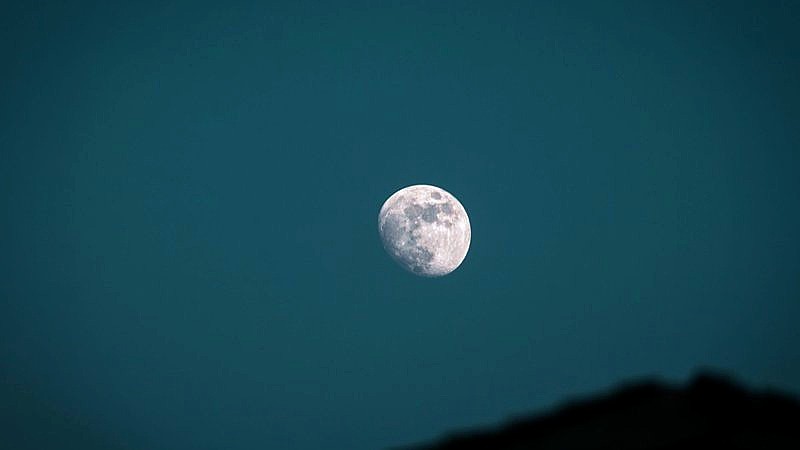
For those of us who couldn’t be in the exact right spot on Earth at the exact right time, or maybe had clouds blocking our view (classic!), the timelapses and videos that emerged were a godsend. Watching a timelapse of this particular event, you see the moon, a pale crescent against the blue sky, slowly, almost deliberately, move towards Venus. Then, like a magician’s trick, Venus just… disappears.
It’s not a sudden blink, but a gradual dimming as the moon’s limb covers it. And then, after a while, it reappears on the other side. Just as slowly. It’s mesmerizing. The sheer challenge of capturing something like this during the day—where atmospheric scattering and the sun’s brightness are working against you—is immense. You need specialized equipment, precise tracking, and a whole lot of patience.
Here’s what most people miss: It makes you really appreciate the skill of astrophotographers. These folks put in serious time and effort, battling light pollution, weather, and technical glitches, just to share these incredible views with the rest of us. Without them, most of us would never get to witness such a delicate, fleeting phenomenon. They’re the real MVPs, giving us a front-row seat to the cosmos.
Don’t Miss the Next Sky Spectacle: How to Stay Informed
So, how do you make sure you don’t miss the next great sky show? Because trust me, once you’ve seen one of these, you’ll want to see more. The good news is, there are tons of resources out there to help you track future celestial events. I’ve got a couple of apps on my phone that are fantastic for this, like SkyView Lite or Star Walk 2. They show you what’s in the sky above you in real-time. Super handy.
Websites are great too. Sites like Space.com, EarthSky, or even NASA’s own calendar of events will list upcoming meteor showers, planetary conjunctions, and yes, even potential occultations. Set yourself some reminders! A well-timed alert can be the difference between seeing something incredible and just hearing about it later.
A word of caution: if you’re ever looking at solar events, like a partial solar eclipse, ALWAYS use proper eye protection. Seriously. Don’t risk your eyesight for a photo op. But for things like a moon and Venus alignment, or other planetary sightings, it’s generally safe to look up directly, though binoculars or a small telescope will always enhance the experience. They really make a huge difference.
My biggest tip? Just look up more often. Seriously. We spend so much time looking down at our phones, or at our homes, that we forget about the incredible show happening above us every single day and night. You never know what you might catch. A really bright shooting star. An unexpected satellite. The feeling of seeing something truly rare, like that recent daytime lunar occultation, is just unbeatable. It puts things in perspective. Makes you feel small, in a good way. And sometimes, that’s exactly what we need to appreciate the bigger picture, even when we’re knee-deep in home repairs.
Frequently Asked Questions
Q: what’s a lunar occultation?
A: A lunar occultation happens when the Moon passes in front of a more distant celestial object, like a planet or star, temporarily blocking it from our view on Earth. It’s essentially the Moon ‘eclipsing’ another object.
Q: How rare is it to see Venus disappear behind the moon during the day?
Fair warning: A: Seeing Venus disappear behind the Moon is somewhat rare, but doing so during the daytime makes it exceptionally uncommon. The visibility depends on precise alignment and clear sky conditions for observers in specific locations.
Q: Do I need special equipment to watch a lunar occultation?
A: While many occultations can be seen with the naked eye if the object is bright enough, binoculars or a small telescope will significantly enhance the view and allow you to see more detail, especially for fainter objects or during twilight.
Q: What’s the difference between an occultation and an eclipse?
A: An occultation is when a larger, closer object (like the Moon) blocks a smaller, more distant object from view. An eclipse is typically when one celestial body passes into the shadow of another, such as the Moon passing into Earth’s shadow (lunar eclipse) or the Moon blocking the Sun (solar eclipse).