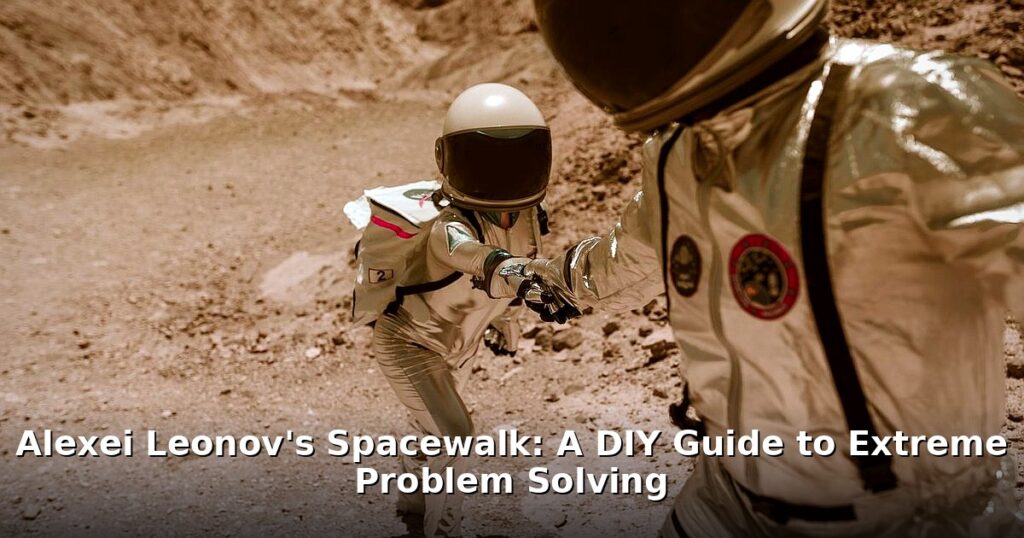

If you’ve been looking into Alexei Leonov spacewalk, imagine this: you’ve been training for years, pushing your body and mind to the absolute limit. You’re about to do something no human has ever done before – step out into the void of space. The whole world is watching, and your nation’s pride rests on your shoulders. Exciting, right? Terrifying? Absolutely. Now, imagine doing all that, only to find your carefully designed gear suddenly turning against you, threatening to leave you stranded.
Table of Contents
That’s not some far-fetched sci-fi plot. That was the very real, terrifying experience of Soviet cosmonaut Alexei Leonov on March 18, 1965. His mission was to perform the world’s first spacewalk, a monumental achievement in the escalating Space Race. But what started as a triumphant moment quickly became a desperate fight for survival.
The year 1965 was a pressure cooker for both the U.S. and the Soviet Union. The Space Race wasn’t just about scientific discovery; it was a Cold War proxy battle, a contest of ideologies played out against the backdrop of the cosmos. After Gagarin’s first orbital flight, the Soviets were keen to maintain their lead. The next big milestone? A human stepping outside a spacecraft. An Extravehicular Activity, or EVA. Check out our guide on Gold’s Cosmic Origin: The Stellar Birth of Earth’s Precious Metal. We covered this in Comet 67P’s Stinky Cloud: Life’s Cosmic Recipe Uncovered.
The Voskhod 2 mission was specifically designed for this purpose. It was essentially a modified Vostok capsule, but with a crucial addition: a collapsible airlock. This allowed one cosmonaut to exit while the other remained inside, maintaining the cabin pressure. A clever piece of engineering, at least in theory.
Alexei Leonov was the man chosen for this historic feat. A former fighter pilot, he was known for his courage and calm under pressure. He’d trained relentlessly, practicing in vacuum chambers, meticulously learning every detail of his Berkut spacesuit. The anticipation must have been incredible, a mix of awe and sheer terror. He was about to make history. Pretty wild, right?
And he did. For a brief, glorious moment, he floated free, tethered to Voskhod 2 by a single umbilical. He later described it as an “ocean of light” where the stars were “everywhere.” A truly profound experience, a giant leap indeed. But then, things started to go seriously wrong. Just something to think about.
When DIY Goes Sideways: Alexei Leonov’s Spacewalk Drama
You might not expect this, but The moment Leonov pushed off the airlock and truly entered the vacuum of space, his suit began to balloon. The Berkut, designed to maintain a stable internal pressure of 5.8 psi (0.4 atmospheres), reacted predictably but catastrophically to the lack of external pressure. It became rigid, like a giant, overinflated balloon. His hands pulled away from his gloves, his feet from his boots. He couldn’t bend his knees, couldn’t reach the camera mounted on his chest, couldn’t even operate the controls on his cuffs.
It was a classic design oversight, a miscalculation in the face of an unprecedented environment. The engineers had designed a suit that held pressure, but they hadn’t fully accounted for the complete absence of external pressure. Without the vacuum acting on the suit to compress it, the internal pressure simply expanded the fabric. A big difference. This wasn’t just an inconvenience; it was a life-threatening situation. Leonov was essentially trapped inside a rigid, unyielding shell, drifting further and further from the airlock.
I know a thing or two about things not fitting. Not quite life-or-death, thankfully, but I once bought a new refrigerator – a lovely, shiny, slightly-too-large refrigerator – without properly measuring the doorway to my kitchen. Oh, I measured the space in the kitchen. That was fine. But the doorway? Nope. Not even close. We ended up having to take the fridge doors off, the kitchen door off its hinges, and then, in a moment of sheer desperation, unscrew the doorframe itself. It was a Saturday project that bled into Sunday, involved a lot of sweating, some colorful language, and nearly ended with a divorce. Not great. But at least my life wasn’t hanging in the balance, like Leonov’s.
The cosmonaut suit malfunction was far more serious. With every passing minute, Leonov’s peril grew. He was supposed to re-enter the airlock headfirst, but with his suit so stiff, it was impossible. He tried to pull himself back in, but the ballooned suit wedged him in the opening. He was stuck.
Bleeding Oxygen: A Desperate Act to Get Back Inside
Time was running out. Leonov’s oxygen supply was dwindling, his body temperature was rising dangerously, and Voskhod 2 was rapidly approaching orbital darkness. If he couldn’t get back inside before they hit the shadow side of Earth, he’d be plunged into frigid darkness, his chances of survival plummeting.
That’s when he made a critical decision, one that wasn’t in any manual. He decided to bleed off some of the internal pressure from his suit. There was a small, experimental valve on his glove. He knew that reducing the pressure meant risking decompression sickness, the dreaded “bends” that can afflict divers who ascend too quickly. But it was his only option. He slowly, carefully, opened the valve, releasing precious oxygen into the vacuum. The suit began to deflate, ever so slightly.
The physical toll was immense. He was already exhausted from struggling against the suit’s rigidity, his heart rate soaring. Now, he was intentionally putting himself in a dangerous physiological state. With his suit partially deflated, he managed to bend his limbs enough to force himself into the airlock, but not headfirst as planned. He had to go in feet first, a contorted, agonizing maneuver. It was like trying to stuff a wet sleeping bag into a tiny sack. Pure brute force and desperation.
He squeezed and pushed, inch by painful inch, until he was finally inside the airlock. He was so overheated that perspiration filled his suit, sloshing around his boots. He emerged from the airlock, gasping, soaking wet, and on the verge of heatstroke. He had cheated death by mere moments, a harrowing experience that lasted just over 12 minutes but felt like an eternity. The first spacewalk challenges were far greater than anyone had anticipated.
This whole ordeal taught me a valuable lesson about adapting plans when things don’t fit, literally and figuratively. In home improvement, you often hit snags. You cut a piece of wood slightly too short, or a pipe connection doesn’t quite seal. My first reaction used to be panic, or anger. Now, I try to channel my inner Leonov (minus the life-threatening risks, obviously). Step back. Assess. What’s the unconventional solution? Sometimes, you have to deviate from the instructions, even if it feels risky, to make things work. It’s about creative problem-solving under pressure.
Beyond the Spacewalk: The Harrowing Return to Earth
You’d think after surviving the spacewalk, the worst was over for Leonov and his co-pilot, Pavel Belyayev. You’d be wrong. The Voskhod 2 mission seemed determined to throw every possible curveball at them.
During reentry, another series of critical malfunctions occurred. A faulty sensor meant the automatic guidance system failed, and they had to switch to manual control. Belyayev, the pilot, had to manually orient the spacecraft using a periscope, a task made incredibly difficult by the tumbling motion and the fact that the two modules (descent and instrument) had failed to separate cleanly. This caused them to spin wildly, subjecting the cosmonauts to crushing G-forces.
They barely managed to correct the orientation and initiate retrofire. But because of the manual intervention and the earlier issues, they landed way off course – hundreds of miles from their intended landing site in Kazakhstan. They touched down deep within the remote, snow-covered forests of the Perm region in Siberia. Imagine surviving space, only to find yourself stranded in a desolate wilderness, surrounded by wolves and bears, in freezing temperatures. Not exactly a soft landing.
For two days, Leonov and Belyayev waited for rescue, enduring bitter cold and the psychological strain of their situation. They had to light fires, ration their meager supplies, and fend off wildlife. Rescuers eventually found them, but the forest was too dense for a helicopter landing. They had to wait another night, with rescuers dropping supplies. The next day, they were finally extracted, having proven their resilience not just against the vacuum of space but against the harshness of Earth itself.
What this teaches us about unexpected project setbacks is profound. You can plan meticulously, anticipate every step, but life (or space, or a dodgy plumbing connection) will always throw you a curveball. The key isn’t to avoid problems entirely – that’s impossible. The key is to build in flexibility, to have contingency plans, and most importantly, to develop the mental fortitude to adapt when things inevitably go wrong. That stubborn faucet, that crooked shelf, that paint drip – they’re all just smaller versions of Siberia, really. Well, maybe not quite, but you get the idea.
The Legacy of Alexei Leonov’s Spacewalk
Despite the terrifying near-disaster, Leonov’s Alexei Leonov spacewalk was a monumental success. He had proven that humans couldn’t only survive but function outside a spacecraft. The lessons learned from the Berkut suit’s ballooning were invaluable. Future spacesuits would incorporate complex restraint layers and joint designs to prevent such issues, making EVAs safer and more practical.
The entire Voskhod 2 mission, with its slew of history of spacewalks challenges, highlighted the incredible bravery, ingenuity, and sheer resilience of the early cosmonauts. Leonov wasn’t just a pilot; he was an explorer, a problem-solver, and a survivor. His quick thinking under immense pressure saved his life and paved the way for all future spacewalks, from repairing the Hubble Space Telescope to assembling the International Space Station.
And that, my friends, is a pretty good metaphor for tackling home projects. You’ve got to be brave enough to start, ingenious enough to figure out how things work (or don’t), and resilient enough to push through when everything seems to be going wrong. Think on your feet, adapt your plans, and don’t be afraid to take a calculated risk if it’s the only way forward. Who knows, your next DIY project might just require a little “space fix” thinking. No joke.
Frequently Asked Questions
Q: Who performed the first spacewalk?
A: Soviet cosmonaut Alexei Leonov performed the first spacewalk on March 18, 1965, during the Voskhod 2 mission. He was outside the spacecraft for 12 minutes and 9 seconds.
Q: What problems did Alexei Leonov encounter during his spacewalk?
A: Leonov’s spacesuit ballooned significantly in the vacuum of space, making it rigid and difficult to move. This nearly prevented him from re-entering the Voskhod 2 spacecraft’s airlock. He had to bleed oxygen from his suit to reduce its size.
Q: How did Leonov get back into the spacecraft?
Look, A: To get back inside, Leonov opened a valve to intentionally reduce the internal pressure of his spacesuit, deflating it enough to squeeze back into the airlock. This was a dangerous maneuver as it risked decompression sickness.
Q: What was the name of the spacecraft for the first spacewalk?
A: The spacecraft for the first spacewalk was Voskhod 2. It was a Soviet mission designed specifically to achieve the world’s first extravehicular activity (EVA).