
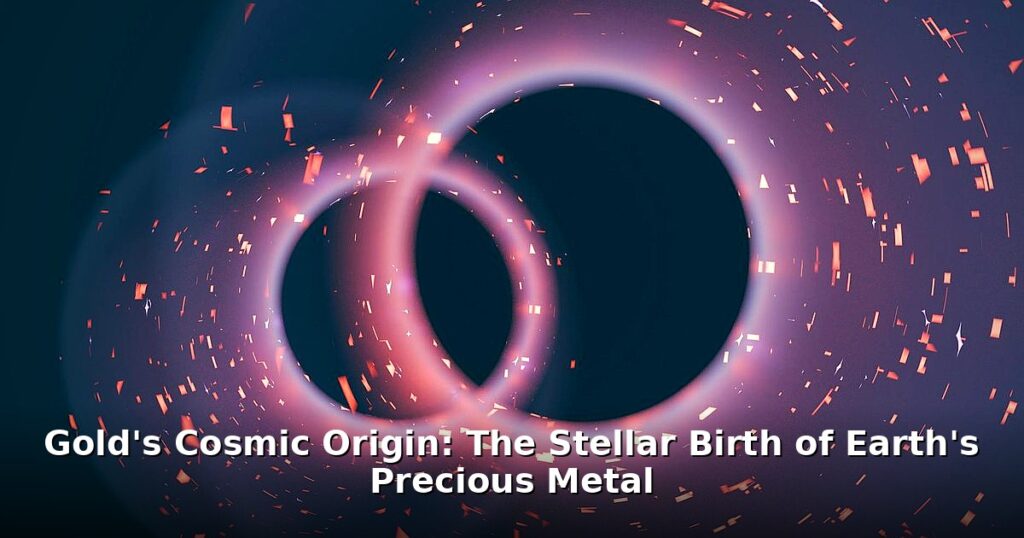

If you’ve been looking into gold’s cosmic origin, you probably think of gold as something dug out of the ground, right? We all do. We picture miners, dusty tunnels, the glint of a nugget in a pan. For centuries, humanity has toiled to extract this shining metal from the Earth’s crust, making it a symbol of wealth, power, and enduring love. But what if I told you that every single speck of gold you’ve ever seen – from the smallest flake to the heaviest bar in a bank vault – didn’t actually come from Earth at all?
Table of Contents
It’s true. The very ground we walk on, as rich as it seems in some places, isn’t the birthplace of this incredible element. The real story of gold’s origin is far more dramatic, more ancient, and frankly, more mind-blowing than any mining tale. It’s a story that starts billions of years ago, in the most violent corners of the cosmos. The gold’s cosmic origin isn’t just a fun fact; it fundamentally changes how you might look at that wedding ring on your finger.
Beyond the Mine: The True Source of Gold
We’ve spent millennia obsessed with gold. Empires rose and fell over it. Explorers crossed oceans for it. We’ve developed incredible technologies, from panning to massive open-pit mines, all to get our hands on this shiny, malleable, non-corroding metal. And because it’s so difficult to find and extract, we’ve always perceived it as incredibly rare and, therefore, incredibly valuable. Check out our guide on Comet 67P’s Stinky Cloud: Life’s Cosmic Recipe Uncovered. We covered this in Meteor Explodes Over US, Shakes Homes: What We Know.
You might not expect this, but But the truth is, the gold we find on Earth is just a tiny, tiny fraction of what’s out there. The vast majority of it, the very building blocks of gold atoms, were forged in an event so powerful, so energetic, that it makes a supernova look like a firecracker. Earth itself is merely a temporary resting place for these cosmic travelers.
Think about that for a second. Every single atom of gold that makes up your jewelry, your coins, or even the tiny contacts in your electronics, was created somewhere else. Far, far away. And not in a gentle, slow process either. Oh no. We’re talking about beginnings so violent they defy imagination.
The Violent Birth of Gold: Neutron Star Collisions
Here’s the thing — So, if gold isn’t made on Earth, where does it come from? The answer lies in what happens when dead stars collide. Not just any dead stars, mind you, but a particular, incredibly dense type known as neutron stars.
What are Neutron Stars?
Imagine a star much, much larger than our sun. When these massive stars reach the end of their lives, they don’t just gently fizzle out. They explode in a spectacular supernova, shedding most of their outer layers. What’s left behind, if the star was massive enough but not too massive to form a black hole, is an incredibly dense core: a neutron star. Huge.
And I mean dense. We’re talking about an object with a mass greater than our sun, but squeezed into a sphere only about 12 miles (20 kilometers) across. A sugar cube-sized piece of neutron star material would weigh billions of tons. Billions! It’s essentially a giant atomic nucleus, packed so tightly that protons and electrons are forced together to become neutrons. These things spin incredibly fast, often hundreds of times per second, and have magnetic fields a trillion times stronger than Earth’s.
When Two Giants Merge: How Gold is Formed in Space
Now, here’s where the magic (or rather, the extreme physics) happens for the stellar nucleosynthesis of gold. Sometimes, two neutron stars, locked in a gravitational dance, slowly spiral inward towards each other. This dance can last billions of years, but eventually, they get close enough that gravity takes over completely. What follows is an event known as a neutron star merger or collision. And it’s truly catastrophic.
When these two super-dense objects finally smash into each other, the energy released is mind-boggling. It’s so powerful that it creates ripples in spacetime itself, known as gravitational waves, which we can actually detect here on Earth. For instance, the LIGO and Virgo observatories detected such an event, GW170817, in 2017, which provided direct evidence for this phenomenon. You can read more about it on NASA’s website: NASA – Cosmic Collusion.
Here’s the thing — But beyond the gravitational waves, something incredible happens to matter. The collision heats up the material to billions of degrees, creating an environment absolutely awash with free neutrons. These neutrons are essential for what’s called the “rapid neutron capture process,” or the r-process.
In the r-process, atomic nuclei rapidly absorb a huge number of these free neutrons before they have a chance to decay. With so many extra neutrons, the nuclei become unstable and quickly undergo beta decay, transforming some of those neutrons into protons. This rapid addition of protons is what builds up heavier and heavier elements on the periodic table. And wouldn’t you know it, gold (atomic number 79) is one of the primary elements forged in this spectacular cosmic furnace.
The sheer scale of this creation is astonishing. A single neutron star collision can produce hundreds of Earth-masses of gold and other precious metals like platinum and uranium. Think about that: one event, enough gold to make our entire planet look like a small nugget.
From Cosmic Dust to Your Jewelry: Gold’s Journey to Earth
So, these unimaginably violent collisions forge all this gold. But how does it get from there, billions of light-years away and billions of years ago, to a riverbed in California or a mine in South Africa, and eventually onto your finger? It’s a long, epic journey.
Once created, the gold atoms, along with other heavy elements, are blasted out into the vast emptiness of space by the force of the collision. They become part of the interstellar medium—the gas and dust that floats between stars. Over immense stretches of time, these elements mingle with material ejected from other stellar events, like supernovae, which also play a role in dispersing elements throughout galaxies. And that matters.
Gravity, the cosmic architect, slowly pulls these diffuse clouds of gas and dust together. In one such cloud, billions of years ago, our own solar system began to form. The gold atoms, forged in those ancient, distant neutron star mergers, were part of that primordial mix. As the cloud collapsed, forming our sun at its center and a swirling disk of material around it, those gold atoms were incorporated.
Eventually, bits of that swirling disk began to clump together, forming planets. Earth was one of them. So, the gold we find here today isn’t native; it’s an extraterrestrial immigrant, a relic from a cosmic cataclysm that predates our sun and planet.
Why Gold is Rare (and Precious) on Earth
Given that hundreds of Earth-masses of gold can be created in a single neutron star collision, you might wonder why it’s so rare and valuable here. This comes down to a few factors.
Firstly, while a lot is produced in these events, the events themselves are rare. They don’t happen every day, even in a galaxy as vast as the Milky Way. And when they do, the gold is scattered across incredible distances. So, while the universe has plenty of gold, it’s spread incredibly thin.
Secondly, when our Earth was forming, it was essentially a molten ball of rock and metal. Gold, being a very dense element, along with other heavy elements like iron and nickel, tended to sink towards the planet’s core due to gravity. So, the vast majority of Earth’s gold isn’t in its crust, where we can get at it, but locked away in the inaccessible depths of the core. The gold we do find in the crust is thought to be from later bombardments by asteroids and comets after the Earth had cooled and solidified somewhat. These impactors brought their own share of cosmic gold, which then remained closer to the surface.
This contrasts sharply with elements like carbon, oxygen, or iron, which are formed in less extreme stellar processes (like within the cores of stars or during regular supernovae) and are therefore much more abundant and accessible. So, while we talk about the precious metal formation in these cosmic events, it’s the scarcity of accessible gold on Earth that truly drives its value.
Appreciating Gold’s Cosmic Origin in Everyday Life
The next time you see a piece of gold, pause for a moment. Whether it’s a simple chain, a historical artifact, or the intricate details on a watch, you’re not just looking at a shiny metal. You’re holding a piece of cosmic history. It’s a tangible link to events that happened billions of years ago, in a galaxy far, far away. Each atom tells a story of unimaginable power and destruction, of stars dying and being reborn in a new, metallic form.
It certainly gives me a different perspective on my own wedding ring. It’s not just a symbol of love; it’s a tiny, ancient artifact, a fragment of stellar violence, the universe’s incredible ability to create beauty from chaos. And it reminds you that everything, even the most mundane object, can have an extraordinary story if you just dig a little deeper. Or, in this case, look a little further out into the cosmos.
This process of creating elements heavier than iron through the r-process isn’t unique to gold. Platinum, uranium, and many other heavy elements share a similar violent, cosmic birthplace. It’s a humbling thought, connecting us all to the grand the universe. What a journey these atoms have had, just to end up here, on our little blue planet.
Frequently Asked Questions
Q: Where does all the gold on Earth originally come from?
A: Almost all the gold on Earth originated from the violent collision of dead stars, specifically neutron stars, billions of years ago. These cosmic events forged heavy elements like gold through a process called rapid neutron capture, scattering them across the universe.
Q: what’s a neutron star collision and how does it create gold?
A: A neutron star collision is when two incredibly dense remnants of massive stars merge. The extreme conditions, immense pressure, and abundant neutrons during this merger allow for the creation of elements heavier than iron, including gold, through a rapid neutron capture process.
Q: Is gold still being created in the universe today?
A: Yes, gold is still being created in the universe today wherever neutron star collisions occur. These events are rare but continue to happen across galaxies, enriching the cosmos with heavy elements.
Q: Why is gold considered a precious metal if so much is created in space?
A: While massive amounts of gold are created in cosmic events, these events are rare and the gold is dispersed across vast distances. On Earth, gold is rare because only a tiny fraction of this cosmic gold was incorporated into our planet during its formation, and much of it sank to the core, making it scarce and difficult to access in the crust.