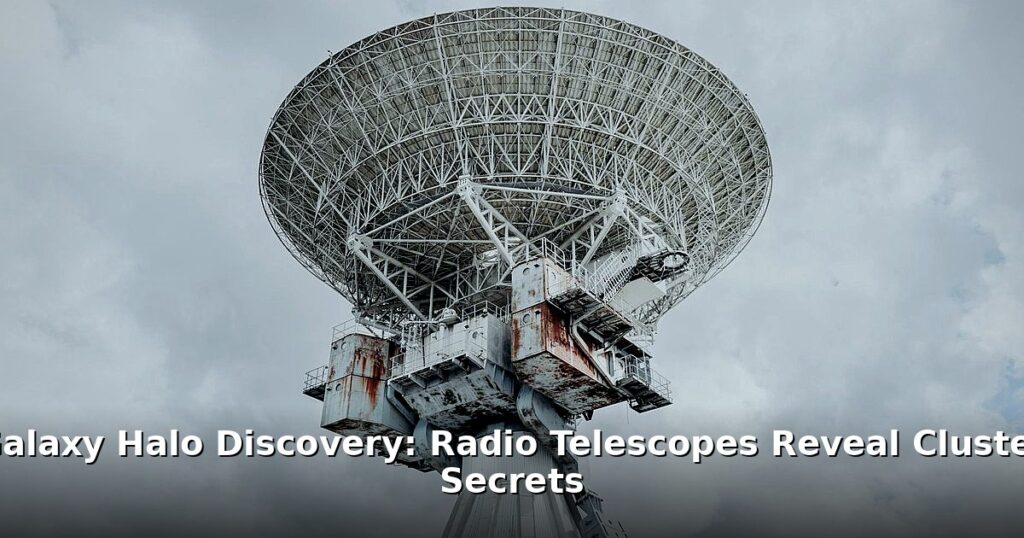

You know how sometimes you look up at the night sky and think about what’s really out there? I do. All the time. And scientists have just found something pretty amazing: a ginormous, 3.3-million-light-year-wide galaxy halo. It’s like finding an extra room in your house that you never knew existed, only this room is filled with… well, intergalactic gas and dark matter. Pretty cool, right?
Table of Contents
- Unveiling the Invisible: The Discovery of the Giant Galaxy Halo
- What Radio Telescopes Tell Us About This Galaxy Halo
- A Quiet Cluster with a Loud Secret: Why This Discovery Matters
- The Intergalactic Medium: what’s It and Why Should We Care?
- DIY Astronomy: How to Observe From Home (Without Giant Radio Telescopes)
- Frequently Asked Questions
Unveiling the Invisible: The Discovery of the Giant Galaxy Halo
Galaxy clusters are basically the biggest things held together by gravity in the universe. They’re like cosmic cities, packed with hundreds or even thousands of galaxies, all swirling around each other. And these cities aren’t just galaxies. They’re also filled with hot gas, called the intergalactic medium (IGM), and a whole lot of dark matter – the mysterious stuff that we can’t see but know is there because of its gravitational effects. Think of it like the concrete and rebar that hold up a skyscraper, only you can’t see the concrete or rebar.
The IGM is super important. It’s the stuff between the galaxies in a cluster, and it’s thought to hold a lot of the “missing” matter in the universe. And it’s also a key player in how galaxies form and evolve. The IGM isn’t easy to study though. It’s incredibly diffuse and emits very little light. That’s where radio telescopes come in. Check out our guide on Gravity Tested! What Does It Mean For Home Projects?. We covered this in Sri Lanka’s Ancient Settlement: Rewriting Island History.
Using a network of radio telescopes, astronomers were able to detect incredibly faint radio emissions from this IGM surrounding a particular galaxy cluster. This cluster, unlike others, is surprisingly “quiet,” meaning it doesn’t have a lot of the usual activity like galaxies colliding or supermassive black holes spewing out energy. But despite its quiet nature, it has this enormous halo. It’s a bit like finding a massive, empty ballroom attached to a small, unassuming house. It was unexpected, to say the least.
The size of this galaxy halo is what really grabbed attention. 3.3 million light-years? That’s massive! And the fact that it’s so faint makes it even more intriguing. It suggests that the gas in the halo is very diffuse and not very energetic. But how did such a large, faint halo form in such a quiet cluster? That’s the million-dollar question.
What Radio Telescopes Tell Us About This Galaxy Halo
So, why radio waves? Well, the IGM emits radio waves when electrons whiz around magnetic field lines – a process called synchrotron emission. And because the IGM is so diffuse, these radio waves are incredibly faint. But radio telescopes are designed to pick up these faint signals, allowing astronomers to map the distribution of gas and magnetic fields in the halo.
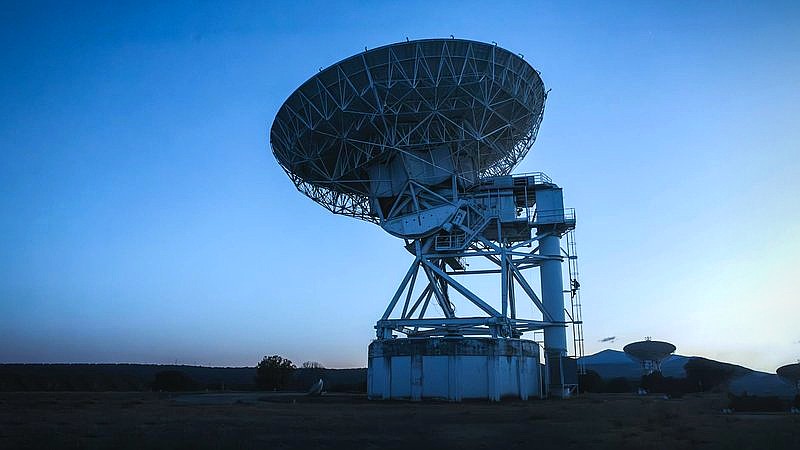
The discovery hinged on using a sophisticated array of radio telescopes. These arrays combine the signals from multiple telescopes to create a much larger, more powerful “virtual” telescope. The bigger the telescope, the fainter the signals it can detect. It’s like having a really, really good hearing aid. For example, the Low-Frequency Array (LOFAR) is a European network of radio telescopes that’s designed to detect faint radio emissions. You can learn more about LOFAR’s capabilities here. Pretty wild, right?
By analyzing the spectrum of radio emissions (basically, the “colors” of the radio waves), astronomers can determine the properties of the gas in the halo. They can measure its temperature, density, and magnetic field strength. This information helps them understand how the halo formed and how it interacts with the galaxies in the cluster. And that information can then be used to map the dark matter halo around the galaxy cluster. Pretty neat, huh?
How does this help map dark matter? Well, the distribution of gas in the halo is influenced by the gravity of the dark matter. By mapping the gas distribution, astronomers can infer the distribution of the underlying dark matter. It’s like using a weather vane to figure out where the wind is blowing, even if you can’t see the wind itself.
A Quiet Cluster with a Loud Secret: Why This Discovery Matters
Most galaxy clusters are pretty active places. Galaxies are constantly colliding and merging. Supermassive black holes are devouring gas and dust, spewing out huge amounts of energy. But the cluster in question is different. It’s relatively quiet. There’s not a lot of activity going on. This makes the discovery of the large halo even more surprising. It suggests that even in quiet environments, there can be significant amounts of gas and dark matter lurking around.
This discovery has implications for understanding galaxy cluster physics in general. It challenges some of our assumptions about how galaxy halos form and evolve. It suggests that the environment in shaping the properties of these halos. Maybe quiet clusters can still grow large halos, just in a different way than active clusters.
One of the big questions raised by this discovery is how such a large halo formed in a “quiet” cluster. Did the gas gradually accumulate over time? Was there a major merger event in the past that deposited a lot of gas into the halo? These are the questions that astronomers are now trying to answer.
Cosmological simulations are computer models that simulate the formation and evolution of the universe. By comparing the observed properties of the halo to the predictions from these simulations, astronomers can test our understanding of cosmology and galaxy formation. And if the simulations don’t match the observations? That means we need to refine our models and come up with new ideas.
The Intergalactic Medium: what’s It and Why Should We Care?
The intergalactic medium (IGM) is the stuff that fills the space between galaxies. It’s mostly made up of ionized hydrogen and helium, but it also contains trace amounts of heavier elements. Honestly, it’s incredibly diffuse – much more so than the air we breathe. Thing is, it’s like the last wisps of fog on a clear morning. Go figure.
Here’s what most people miss: The IGM is thought to be a reservoir of baryonic matter – the “normal” matter that makes up stars, planets, and us. According to cosmological models, there should be more baryonic matter in the universe than we can see in galaxies and clusters. The IGM is thought to hold a lot of this “missing” matter. And by studying the IGM, we can try to solve the so-called “missing baryon problem.”
Studying the IGM is difficult, but it’s crucial for understanding how galaxies form and evolve. The IGM provides the raw material for galaxy formation. Gas from the IGM can flow into galaxies, fueling star formation and black hole growth. The IGM is constantly interacting with galaxies, exchanging gas and energy. So yeah, the IGM also affects the propagation of light through the universe. It absorbs some wavelengths of light, allowing astronomers to probe its properties.
Future research will focus on studying the IGM in more detail. New telescopes and instruments will allow astronomers to probe the IGM at higher resolution and sensitivity. They will also use different techniques, such as studying the absorption of light from distant quasars, to probe the properties of the IGM along different lines of sight. One area of focus: Better understanding of the distribution of the intergalactic medium. All of this will provide new insights into the nature of this giant galaxy halo and its role in the evolution of the galaxy cluster.
DIY Astronomy: How to Observe From Home (Without Giant Radio Telescopes)
Okay, so you’re probably not going to be able to see this galaxy halo with your backyard telescope. Sorry. They’re just too faint and diffuse. You need massive, specialized radio telescopes to detect them. But that doesn’t mean you can’t participate in astronomy from home!
There are many citizen science projects that allow you to analyze astronomical data. For example, you can help classify galaxies, search for exoplanets, or map the surface of the moon. These projects are a great way to contribute to scientific research and learn more about the universe. Zooniverse is a great starting point: Check out Zooniverse projects here. Not ideal.
Want to learn more about radio astronomy? There are many excellent resources available online and in libraries. You can find websites, books, and videos that explain the basics of radio astronomy and the techniques used to study the universe at radio wavelengths. So get educated!
- Learn about the basic principles of radio astronomy.
- Understand the different types of radio telescopes and their capabilities.
- Explore the various objects and phenomena that can be studied with radio telescopes.
Finally, it’s important to support scientific research. Funding for science comes from a variety of sources, including government grants, private donations, and corporate sponsorships. By supporting science, you’re helping to advance our understanding of the universe and improve our lives.
Frequently Asked Questions
Q: what’s a galaxy halo?
A galaxy halo is a diffuse region of gas, dark matter, and stars that surrounds a galaxy. It extends far beyond the visible disk and contains a significant portion of the galaxy’s mass.
Q: Why is this galaxy halo discovery important?
This discovery provides new insights into the distribution of matter in galaxy clusters and the processes that govern galaxy evolution. The halo’s unusual characteristics challenge existing models and prompt further research.
Q: what’s the intergalactic medium (IGM)?
The IGM is the rarefied plasma that fills the space between galaxies. It contains most of the baryonic matter in the universe and in galaxy formation and evolution.
Q: How do radio telescopes help us study galaxy halos?
Radio telescopes can detect faint faint radio emissions from the IGM, allowing astronomers to map the distribution of gas and magnetic fields in galaxy halos. These observations provide complementary information to optical and X-ray data.
Q: Can I see a galaxy halo with my telescope?
No, galaxy halos are too faint and diffuse to be observed with amateur telescopes. Specialized radio telescopes and other advanced instruments are required for these observations.
This radio telescope discovery of a huge galaxy halo reminds us that there’s still so much we don’t know about the universe. It’s a humbling thought, but also an exciting one. Who knows what other secrets are out there, waiting to be discovered?