
Okay, buttercup, because we’re about to take a whirlwind tour of the cosmos. Forget your home improvement to-do list for a few minutes and prepare for some serious brain-tickling. We’re talking 34 freakin’ cool space facts that’ll make you question everything you thought you knew. Get ready for a cosmic kick in the pants!
Table of Contents
Mind-Blowing Space Facts About Our Solar System
Let’s start close to home, shall we? Our solar system is a pretty weird place, full of surprises. Even the stuff you think you know probably has some hidden strangeness. Big difference.
- The Sun is HUGE. Like, a million Earths could fit inside it. It’s hard to wrap your head around the scale.
- Mercury is a planet of extremes. During the day, temperatures can soar to 800°F (430°C). At night, it plummets to -290°F (-180°C). Talk about needing some serious thermostat adjustments.
- Venus is basically hell. Its atmosphere is toxic, filled with carbon dioxide and sulfuric acid clouds. A runaway greenhouse effect makes the surface temperature hot enough to melt lead. No thanks.
- Mars: Is there life? Was there life? The rovers are searching, and scientists are analyzing data. The possibility of past or present life is still a tantalizing question.
And those are just the rocky planets. The gas giants are even crazier.
- Jupiter’s Great Red Spot is a storm that’s been raging for at least 350 years. It’s bigger than Earth. Imagine the wind damage!
- Saturn’s rings are stunning. They’re made up of billions of particles of ice and rock, ranging in size from grains of sand to houses. I wonder how much that real estate would cost?
- Uranus is tilted on its side. It rotates almost perpendicular to its orbit around the Sun. Some say it was hit by a massive object a long time ago.
- Neptune has supersonic winds. They can reach speeds of over 1,200 mph (2,000 km/h). That’s faster than the speed of sound.
- The Kuiper Belt is a region beyond Neptune that contains icy objects, including Pluto. Poor Pluto, still getting no respect.
Cool Space Facts About Stars and Galaxies
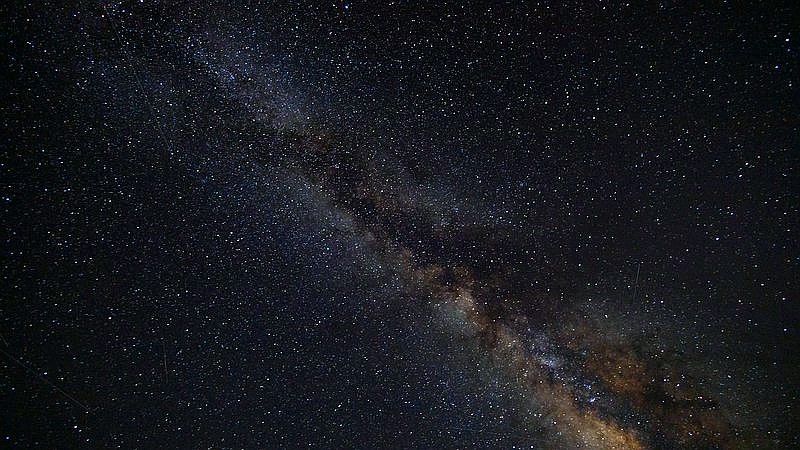
Time to zoom out a bit. Our solar system is just a tiny speck in the Milky Way galaxy, which is itself just one of billions of galaxies in the observable universe. Mind. Blown. Check out our guide on Meteor Shower This Week: See 20 Shooting Stars Per Hour. We covered this in Soil Microbes and Rain: How Tiny Life Affects Rainfall.
- The Milky Way galaxy contains an estimated 100-400 billion stars. Try counting that high. I dare you.
- Stars come in different flavors: red giants, white dwarfs, neutron stars. Each type represents a different stage in a star’s life cycle.
- Supernovas are the explosive deaths of massive stars. They’re some of the most energetic events in the universe. Talk about going out with a bang.
- Black holes are regions of spacetime with such extreme gravity that nothing, not even light, can escape. They’re the ultimate cosmic vacuum cleaners.
And the universe is even bigger than that…
- There are billions of other galaxies beyond our own, each containing billions of stars. It’s hard to even fathom that scale.
- Dark matter and dark energy make up most of the universe. We can’t see them, but we know they’re there because of their gravitational effects. Spooky!
- Quasars are supermassive black holes at the centers of galaxies that are actively feeding on gas and dust. They’re some of the brightest objects in the universe.
- The universe is about 13.8 billion years old and is constantly expanding. Where’s it expanding to? Good question.
Amazing Space Facts About Cosmic Phenomena
Let’s some truly amazing cosmic phenomena. These are the things that make you go “whoa.”
- Nebulae are vast clouds of gas and dust where stars are born. They’re some of the most beautiful objects in the universe.
- The cosmic microwave background radiation is the afterglow of the Big Bang. It’s a faint signal that can be detected in all directions.
- Gamma-ray bursts are the most powerful explosions in the universe. They’re thought to be caused by the collapse of massive stars or the merger of neutron stars.
- Scientists are constantly searching for exoplanets – planets orbiting other stars. Thousands have been discovered so far.
And of course, there are the smaller objects…
- Asteroids and comets are remnants from the early solar system. They’re like cosmic time capsules.
- The possibility of extraterrestrial life is one of the biggest questions in science. Are we alone?
- Gravitational waves are ripples in spacetime caused by accelerating massive objects. They were predicted by Einstein and first detected in 2015.
More Freakin’ Cool Space Facts to Blow Your Mind
Still with me? Good. Because we’re just getting started. Here are some more interesting space facts that’ll really make you think.
- The distances between stars and galaxies are mind-numbing. It takes light years to travel from one to another.
- Time dilation is a real thing. Time passes slower for objects that are moving faster or are in stronger gravitational fields. Thanks, Einstein.
- The Drake equation is an attempt to estimate the number of intelligent civilizations in our galaxy. The numbers are all over the place, but it’s fun to think about. You can even try it yourself!
- The Fermi paradox asks why, if there are so many potential civilizations out there, we haven’t heard from any of them. Are they hiding? Did they destroy themselves? Are we just not listening right?
And let’s not forget our own puny efforts… Seriously.
- Space exploration has been one of humanity’s greatest achievements. But human spaceflight is incredibly difficult and dangerous.
- The potential for future space colonization is exciting, but also presents huge challenges. Can we become a multi-planetary species?
- The sheer beauty and wonder of the cosmos is awe-inspiring. Just look up at the night sky and take it all in.
- And get this: Space is constantly expanding. Faster and faster, they say. So everything’s getting further apart all the time.
Weird Space Facts That Will Make You Question Everything
Now, for the grand finale. These are the amazing space facts that are just plain weird. Prepare to have your mind blown… again.
- Venus rotates backwards compared to most other planets. East to west, instead of west to east. Just to be different, I guess.
- There’s a planet made of diamond. 55 Cancri e is twice the size of Earth and eight times the mass. I wonder if you can mine it.
- Some planets have rings made of water ice. Just like Saturn, but with ice instead of rock.
- Sound doesn’t travel in space because there’s no air. So all those explosions in sci-fi movies? Totally inaccurate.
- Astronauts can’t burp in space. Gravity keeps the liquids and solids in their stomachs. Not great for parties on the ISS.
Frequently Asked Questions
Still scratching your head? I get it. Space is confusing! Here are some common questions about the cosmos.
what’s the biggest planet in our solar system?
What surprised me was that Jupiter is the largest planet in our solar system. Its diameter is about 11 times that of Earth.
How far away is the nearest star?
Look, Proxima Centauri is the closest star to our sun. It’s about 4.24 light-years away, which is about 25 trillion miles.
what’s a black hole?
A black hole is a region of spacetime with such strong gravity that nothing, not even light, can escape from it. You can learn more about black holes at NASA’s website.
what’s the Big Bang?
The Big Bang is the prevailing cosmological model for the universe. It describes the universe as expanding from an extremely hot, dense state about 13.8 billion years ago.
Is there life on other planets?
Scientists haven’t yet discovered definitive proof of life beyond Earth, but the search continues. There are many planets in the “habitable zone” of their stars, where liquid water (and therefore life as we know it) could exist.
So, there you have it – 34 freakin’ cool mind blowing space facts to ponder. I hope you enjoyed this little detour from your usual home improvement projects. Space might seem far away, but it affects all of us. Now go outside tonight, look up at the stars, and remember just how small we really are. It’s a humbling thought, isn’t it?