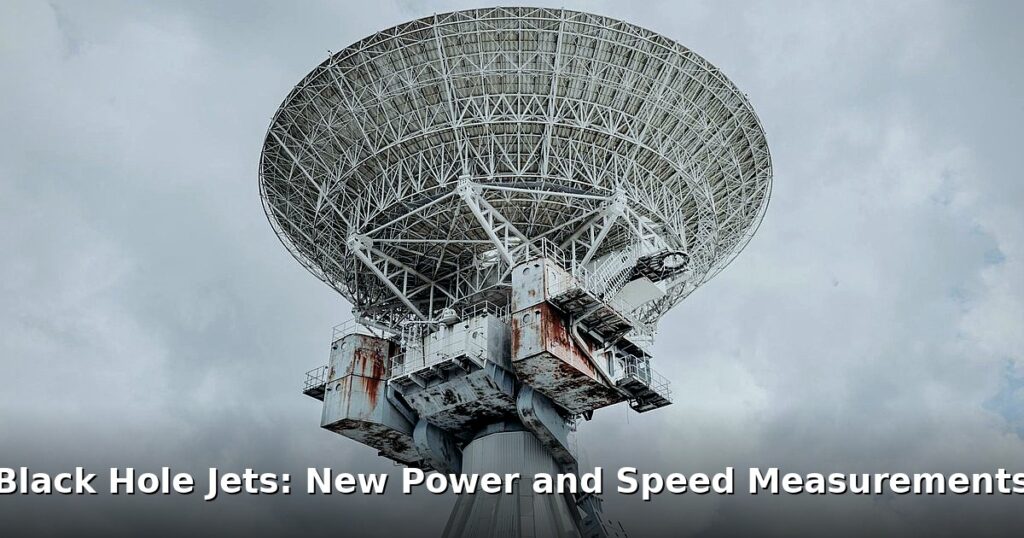

Ever tried blasting a clogged drain with a pressure washer? That’s kind of what black hole jets are like, only on a scale that makes your plumbing problems look like… well, nothing. These jets are among the most powerful phenomena in the universe, and scientists have just taken a major leap forward in understanding them.
Table of Contents
Unveiling the Power of Black Hole Jets
So, what exactly are these cosmic blowtorches? Black hole jets are streams of matter and energy that erupt from the vicinity of black holes, often traveling at near-light speed. They’re important because they influence the evolution of galaxies, shaping star formation and distributing energy across vast cosmic distances. Think of them as the universe’s way of rearranging furniture on a grand scale. Worth it.
New astrophysics research has focused on directly measuring the power and speed of these jets with unprecedented accuracy. The object of study? A supermassive black hole residing in the galaxy 3C 273, a quasar billions of light-years away. I know, the names aren’t exactly catchy, but the findings? Absolutely mind-blowing. But how did they actually do it? Check out our guide on European Mars Rover: Finally Ready for Launch!. We covered this in Martian Oceans: Finding Ancient Shorelines on Mars.
How Astronomers Measured the Black Hole Jets’ Speed
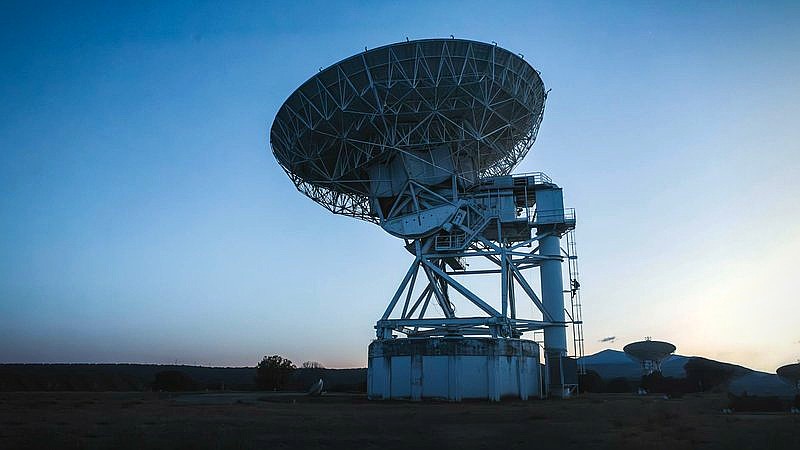
Measuring something so incredibly distant and fast requires some seriously sophisticated technology. Astronomers employed Very Long Baseline Interferometry (VLBI), a technique that links together multiple radio telescopes across the globe to act as a single, Earth-sized telescope. Big difference.
These telescopes captured the radio wave emissions from the 3C 273’s black hole jet. Then came the hard part: analyzing the data. It’s not like they could just point and shoot. They had to sift through mountains of information to isolate the faint signals from the jet and determine its speed and direction. It’s like trying to find a specific grain of sand on all the world’s beaches.
The Challenges of Measuring Black Hole Jets
Measuring black hole jet speed isn’t a walk in the park. Distance is a huge issue. We’re talking about objects billions of light-years away, so the signals are incredibly faint. And the jets themselves are dynamic, with constantly changing structures and velocities. Talk about a moving target!
Another challenge? Overcoming interference. Radio waves from Earth-based sources (think cell phones and satellites) can contaminate the data. Astronomers need to carefully filter out these signals to get a clear picture of the jet. You know, I tried to photograph the moon once with my phone. Total failure. Just a blurry white blob. It’s kind of like that, but a billion times more complex. And they succeeded. Amazing.
Calculating the Mind-Blowing Power Output
Once the speed of the black hole jets was determined, the next step was calculating its power. This involved using complex equations based on the principles of physics and astrophysics. The results? Well, let’s just say they’re staggering.
The power output of the jet from 3C 273 is estimated to be equivalent to the energy released by trillions of suns. Trillions! To put it another way, it’s like focusing the energy of every star in our galaxy into a single, narrow beam. Not bad.
This mind-boggling power has significant implications for understanding the black hole’s accretion disk – the swirling mass of gas and dust that feeds the black hole – and its surrounding environment. The jet can heat up the surrounding gas, trigger star formation, or even shut it down entirely. It’s a cosmic thermostat, controlling the temperature of its galactic neighborhood.
What These Black Hole Jets Measurements Tell Us
These measurements of measuring black hole jets provide valuable insights into the fundamental physics of black holes. They help us understand how these objects convert matter into energy and how they interact with their surroundings. They also help refine our understanding of the theoretical models that describe black hole behavior.
Specifically, these measurements help constrain the models of jet formation and propagation. It helps us understand the composition of the jet, the magnetic fields that confine it, and the mechanisms that accelerate particles to near-light speed. There’s still so much we don’t know, but this is a big step forward. And I mean, a big step.
What are the next steps in this research area? Scientists want to study a larger sample of black hole jets to see if the results from 3C 273 are typical or if there’s jet properties. They also want to study the jets at different wavelengths of light, from radio waves to X-rays, to get a more complete picture of their structure and behavior. A never-ending quest for knowledge, right?
The Future of Black Hole Jet Research
You might not expect this, but The future of black hole jet speed research is looking bright. New telescopes and missions are planned that will provide even more detailed observations of these cosmic phenomena. For example, the next generation Very Large Array (ngVLA) will provide a tenfold increase in sensitivity compared to current radio telescopes. See the National Radio Astronomy Observatory website for details: https://public.nrao.edu/
These new instruments will allow astronomers to probe the jets closer to their source, revealing the processes that launch and collimate them. They will also allow us to study the interaction of the jets with the surrounding environment in greater detail.
What potential discoveries could be made? Perhaps we’ll discover new types of black hole jets, or uncover new mechanisms that drive their formation and evolution. Maybe we’ll even find evidence of new physics at play in these extreme environments. The possibilities are endless. I find it all pretty inspiring.
Frequently Asked Questions
Q: What are black hole jets made of?
Black hole jets are streams of plasma, superheated matter composed of ionized gas, that are ejected from the region surrounding a black hole. These jets often contain electrons, positrons, and atomic nuclei accelerated to near-light speed.
Q: How fast do black hole jets travel?
Black hole jets can travel at speeds approaching the speed of light. The recent research focused on measuring black hole jets speeds with greater accuracy than ever before.
Q: Why are black hole jets important?
Real talk: Black hole jets play a crucial role in the evolution of galaxies. They can deposit vast amounts of energy into the surrounding intergalactic medium, influencing star formation and the overall structure of galaxies.
Q: How do astronomers measure black hole jets?
What surprised me was that Astronomers use radio telescopes and techniques like Very Long Baseline Interferometry (VLBI) to observe the radio waves emitted by these jets. Analyzing the radio waves allows them to determine the jet’s speed, power, and composition. Also, see the Event Horizon Telescope project for more information: https://eventhorizontelescope.org/
Q: Can black hole jets affect Earth?
Here’s what most people miss: While black hole jets are incredibly powerful, they’re located at vast distances from Earth. The jets don’t pose a direct threat to our planet. Not ideal.
It’s amazing to think about the sheer power contained within these cosmic phenomena. And this new research is another step towards understanding the universe’s biggest mysteries. Who knows what we’ll discover next? Keep looking up!