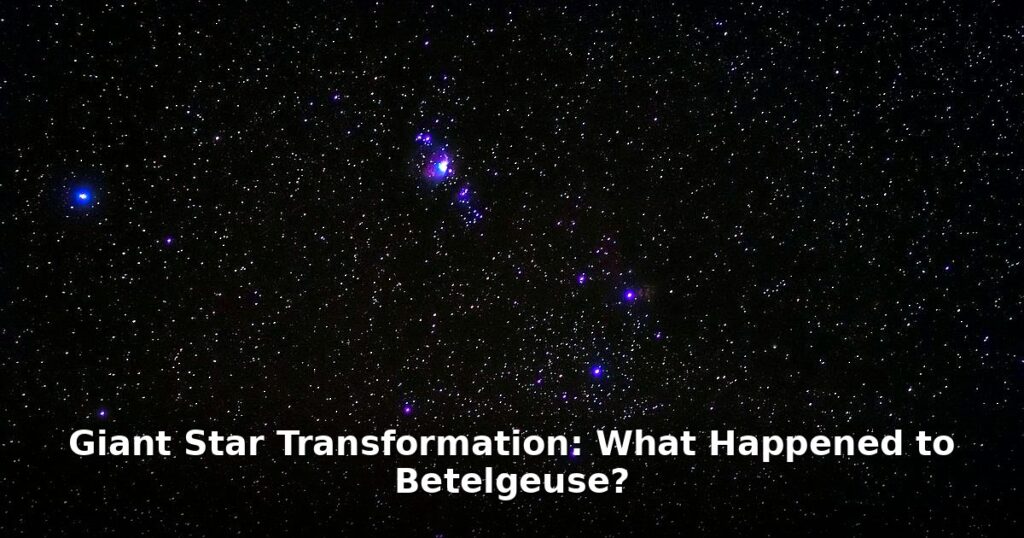

You ever look up at the night sky and wonder what those twinkling lights are really doing up there? I do. And lately, one star in particular has been keeping astronomers—and casual stargazers like me—on their toes: Betelgeuse.
Betelgeuse: A Red Supergiant’s Claim to Fame
If you know your constellations, you can spot Betelgeuse in Orion. It’s that bright, reddish star that forms Orion’s shoulder. Even if you don’t know your constellations, honestly, it’s pretty easy to find. It just stands out.
But what is Betelgeuse exactly? It’s a red supergiant. Now, “red supergiant” isn’t just a fancy term. It actually tells you a lot about the star. First, “red” means its surface temperature is relatively cool compared to other stars, around 3,500 Kelvin (about 5,800 degrees Fahrenheit). Our Sun, for comparison, is a scorching 10,000 degrees Fahrenheit. Second, “supergiant” means it’s absolutely enormous. Betelgeuse is thought to be somewhere between 700 and 1,000 times the size of our Sun. If it were placed at the center of our solar system, it would extend past the orbit of Mars – maybe even Jupiter! You might also enjoy: Superconductivity Breakthrough: How ‘Ghost’ Photons Change Everything. You might also enjoy: Stop the Squeak: Fixing Noisy Soft-Rigid Friction Points.
Why all the fuss about this particular star? Well, for starters, it’s relatively close to us – only about 700 light-years away. That makes it one of the brightest and most easily observable stars in our sky. And that proximity is why Betelgeuse is so important. It provides astronomers with a unique opportunity to study the life cycle of massive stars up close. It’s a cosmic laboratory, if you will. Plus, let’s be honest, there’s the whole “it might explode any minute now” thing, which definitely adds to the excitement.
The Great Dimming Event: What Happened in 2019-2020?
Things got really interesting in late 2019 and early 2020. Betelgeuse, which is normally quite bright, started to dim. And I mean really dim. Its brightness dropped by more than a factor of two! Suddenly, everyone was talking about it. Was this it? Was Betelgeuse finally about to go supernova?
The astronomical community sprang into action, trying to figure out what was going on. There were several theories floated. One idea was that the star’s surface temperature had cooled significantly, causing it to emit less light. Stars aren’t static. They pulse and change over time. But the temperature change needed to explain the dimming seemed a bit too extreme.
The other, more popular, theory involved dust. Not the kind you find under your couch (though I’ve got plenty of that too, sadly). We’re talking about clouds of dust and gas ejected from the star itself that then blocked some of its light as seen from Earth. This dust cloud idea seemed to fit the observations better, but it needed more evidence. Astronomers used telescopes on Earth and in space, observing Betelgeuse at different wavelengths of light – visible, infrared, ultraviolet – to get a more complete picture of what was happening.
Dust Cloud Explanation: The Most Likely Cause?
So, how does a star like Betelgeuse create these dust clouds? Red supergiants are known to have turbulent atmospheres. Think of it like a pot of boiling water, but instead of water, it’s superheated gas. This turbulence can cause the star to eject material into space. But this material, rich in elements like carbon and silicon, then cools as it moves away from the star. As it cools, these elements can condense into solid particles – dust. Big difference between that and the dust bunnies under my bed. Ick.
And here’s where the infrared observations come in. Infrared light can penetrate through dust clouds, allowing astronomers to see what’s behind them. Observations of Betelgeuse during the dimming event showed an increase in infrared radiation, suggesting the presence of a large amount of dust. This provided strong evidence in support of the dust cloud theory.
To further test this idea, astronomers used computer simulations to model the formation of dust clouds around red supergiants. These simulations showed that it was indeed possible for Betelgeuse to eject a significant amount of dust that could then block its light. These models helped to explain not only the dimming itself but also the shape and distribution of the dust cloud. No joke.
The Star’s Recovery: Betelgeuse Returns to Normal
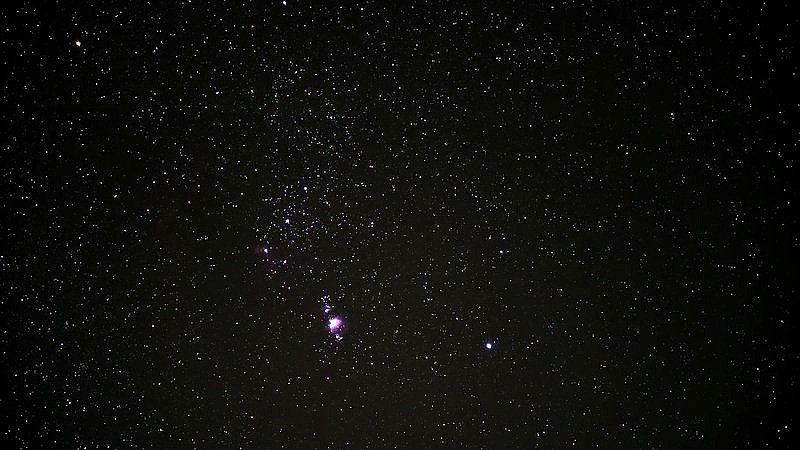
Thankfully (or disappointingly, depending on your perspective!), the “Great Dimming” didn’t last forever. By early 2021, Betelgeuse had started to brighten again, gradually returning to its normal luminosity. The dust cloud, whatever its exact composition, had either dissipated or moved out of our line of sight.
As of now, Betelgeuse seems to have stabilized. It’s still being monitored closely by astronomers around the world, but there haven’t been any further dramatic dimming events. But, given the star’s history, no one’s counting anything out. The plan is to keep a close watch on the star, using a variety of telescopes and techniques, to learn more about its behavior and, hopefully, to catch it in the act of ejecting more dust or, perhaps, even going supernova.
Supernova Speculation: Is Betelgeuse About to Explode?
Okay, let’s get to the big question: Is Betelgeuse about to explode as a supernova? The short answer is: maybe. Eventually. But probably not in our lifetimes.
A supernova is what happens when a massive star reaches the end of its life. The star runs out of fuel for nuclear fusion in its core. Worth noting — the core then collapses under its own gravity, triggering a massive explosion that blasts the star’s outer layers into space. These explosions are some of the most energetic events in the universe, visible across vast distances.
Betelgeuse is definitely massive enough to go supernova. But the question is, when? Unfortunately, there’s no way to know for sure. Stars don’t exactly send out calendar invites before they explode. “Soon,” in astronomical terms, could mean tomorrow or it could mean 100,000 years from now. Honestly, your guess is as good as mine.
What would a Betelgeuse supernova look like from Earth? Well, it would be spectacular. For a few weeks or months, it would be as bright as the full moon, possibly even visible during the daytime. It would be a truly awe-inspiring sight. And completely harmless to us, by the way. Betelgeuse is far enough away that the explosion wouldn’t pose any danger to Earth. It would just be a really cool show.
What We Learned from Betelgeuse‘s Strange Behavior
So, what did we learn from all this Betelgeuse drama? First, we gained a better understanding of the complex processes that occur in the atmospheres of red supergiants. The dimming event showed us how these stars can eject large amounts of dust and gas, which can then affect their brightness. It’s a dynamic process, far from the static image of stars we often have.
Second, we improved our understanding of dust formation around stars. By studying the dust clouds around Betelgeuse, astronomers were able to learn more about the composition, size, and distribution of these particles. This information is valuable for understanding how stars recycle material back into the interstellar medium, the raw material for future generations of stars and planets.
And finally, the Betelgeuse episode highlighted long-term astronomical observations. By monitoring stars like Betelgeuse over many years, astronomers can detect subtle changes in their behavior that might otherwise go unnoticed. These long-term observations are crucial for understanding the life cycle of stars and the evolution of the universe. Not even close.
Frequently Asked Questions
Why did Betelgeuse suddenly get dimmer?
The most likely explanation is that a cloud of dust formed in front of the star, blocking some of its light. This dust was likely ejected from the star itself and cooled as it moved away.
Is Betelgeuse going to explode soon?
Betelgeuse is nearing the end of its life and will eventually explode as a supernova. However, ‘soon’ in astronomical terms could mean anytime in the next 100,000 years. There’s no way to know exactly when it will happen.
Will a Betelgeuse supernova be dangerous to Earth?
No, the explosion is too far away to pose any direct threat to Earth. It would be a spectacular sight in our sky, possibly visible during the daytime for a short period.
Betelgeuse has offered us a fascinating glimpse into the lives of massive stars. It’s a reminder that the universe is constantly changing, and that even the most familiar objects in the night sky can hold surprises. Will it explode tomorrow? Maybe not. But the universe is patient. And it will happen eventually. So keep looking up. You never know what you might see.